Clemens Heni

Wissenschaft und Publizistik als Kritik

How not to prevent a second Holocaust

Times of Israel, May 9, 2013

The fourth Global Forum for Combating Antisemitism, which is scheduled to be held in Jerusalem this month, is a very important international conference. Fighting anti-Semitism, hatred of Israel, Islamism, anti-Zionism, and the distortion of the Shoah are obviously extremely timely and significant topics, given the genocidal threats from Iran against Israel, the growing hostility toward the Jewish state in many countries in Europe, and throughout the Arab and large parts of the Moslem world, and the recent attempts to delegitimize the hereto-accepted narratives of World War II and the Holocaust throughout post-Communist eastern Europe.

Given the Forum’s significance and the fact that it was created and continues to be hosted by the Israeli Foreign Ministry, the question arises as to why Israel has invited ministers from countries known for promoting the distortion of the Holocaust and the canard of historical equivalency between Nazism and Communism to an event dedicated to fight anti-Semitism and prevent a possible ‘second Holocaust’? Are politicians or representatives of countries known for their efforts to whitewash their own pro-Nazi legacy allies in the fight against Holocaust denial and distortion of history? Some tiny and not powerful countries have learned to pay lip-service to Israel while promoting the above-mentioned Holocaust distortion in their own countries. This is currently the case in Hungary and Lithuania.

In December 2009 at the last meeting of the Global Forum I participated in the efforts to expose and condemn Lithuanian anti-Semitism. In a working group, Professor of Yiddish Dovid Katz and I, supported by British MP John Mann, criticized Lithuanian anti-Semitism and Holocaust distortion. Our words fell on deaf ears and we were shocked and chagrined when the featured guest speaker, the Foreign Minister of Lithuania, failed to address this issue at all, and whitewashed the serious problems his country faced in this regard.

Now, in May 2013, a representative of the Lithuanian government has again been invited as an honored guest to address the fourth Global Forum. Are there no other, more worthy, countries to invite, when it comes to fighting anti-Semitism and unfair criticism of Israel? Was our criticism in December 2009 completely useless?

After the program for this month’s conference was publicized, Efraim Zuroff, the director of the Simon Wiesenthal Center’s Israel office, said senior government officials from Lithuania, Greece, Hungary and Ireland should not be allowed to attend – much less speak at – the Global Forum for Combating Antisemitism.

The opportunity to address the conference by visiting dignitaries should be a prize given to people who are leading the fight against anti-Semitism, and not to individuals representing countries in which the problem is among the worst in Europe, if not the worst.

This was not the first time that the well-known Nazi-hunter had drawn attention to this problem. In December 2009 Zuroff already criticized the invitation of the then Lithuanian Foreign Minister:

I am referring primarily to the invitation to Lithuanian Foreign Minister Vygaudas Usackas to participate as a special guest of the forum, but also to the presence there of two right-wing Hungarian politicians, Zsolt Semjen and Zoltan Balog, both of whom have made very negative comments about Hungarian Jews.

It is somehow both predictable and shocking that high-ranking representatives of these same countries, Lithuania and Hungary, are again slated to deliver speeches at the Global Forum for Combating Antisemitism. They will, of course, not deal with the failures of their own countries since 2009. They will not apologize for a reburial – replete with military honors – of a minister who served in the Nazi puppet government of Lithuania. Nor will they change their radical nationalist policies, including anti-Semitism, in both countries like the equation of red and brown (“Prague Declaration”) or the toleration of anti-Semitic and far-right parties like Jobbik in Hungary.

The same holds for Greece. Greek neo-Nazi party Golden Dawn was supported by Prime Minister Samaras and a member of that anti-Semitic party was elected by the Greek Parliament to the Parliamentary Assembly of the Council of Europe (PACE). A Hungarian extreme right politician from Jobbik was also elected to that very EU body. In March 2013 anti-Semitic and anti-Roma, racist journalist Ferenc Szaniszlo was awarded a prestigious state-sponsored Hungarian award for journalists, the Táncsics prize, given under the auspices of Minister of “human resources.”

Why should Israel honor such countries and governments at an event dedicated solely to fighting anti-Semitism?

The Global Forum for Combating Antisemitism is probably the largest gathering of scholars, activists, politicians, philanthropists, citizens, bloggers, journalists and others in the pro-Israel and anti-anti-Semitism tent. But distortion of the Holocaust remains a key indicator for knowing who Israel’s true friends are, and who are its enemies. Ignoring this in 2013 is shortsighted and self-defeating, just as it was in 2009.


Distorting the first and preventing a second Holocaust?

Troubling invitations spark controversies about the Global Forum in Jerusalem, to be held end of May 2013

by Dr. Clemens Heni


The Global Forum for Combating Antisemitism is a very important international conference. The first one was held in 2007, followed by two more events in 2008 and 2009. May 28-30, 2013, the fourth Global Forum will take place in Jerusalem. Fighting antisemitism, hatred of Israel, Islamism, anti-Zionism, and the distortion of the Shoah are tremendously timely and important topics.

Israel is a tiny country and the only one facing genocidal threats. Anti-Zionism is a religion in Europe and particularly in the Arab world, and parts of the Muslim world. Iran denies the Holocaust and agitates in a Nazi-style against Israel. Islamism is a huge threat on a worldwide level, but particularly in the Middle East, just look at Egypt and the Muslim Brotherhood, Turkey with the more veiled but influential, equally legal form of Islamism and Jihad (remember the Mavi Marmara) or Saudi-Arabia with its decades long spread of Islamist ideology via funding of extremist groups, mosques, cultural centers and the like. Qatar is home of one of the world’s leading Sunni Islamists, Yusuf al-Qaradawi, who urges the Muslim world to fight Israel, who supports suicide bombing by unveiled females and who thanked Hitler for having punished the Jews. No one is criticizing or isolating Qatar for being host of that influential antisemite and his world-wide media network, including al-Jazeera.

Therefore, the Global Forum will be a very important gathering of those dedicated to fight Islamism, Muslim antisemitism, anti-Zionism and hatred of Israel in all its forms.

However, is it a good idea to invite someone to an event dedicated to fight antisemitism and a possible ‘second Holocaust’ who is known for distorting, veiling or even affirming the Holocaust? Are politicians or representatives of countries known for their efforts to whitewash their own pro-Nazi legacy allies in the fight against Holocaust denial and distortion of history? Is it a reflection and sign of a change in public relations to invite the very same country to the very same event four years later, again?

Some tiny and not powerful countries have learnt to pay lip-service to Israel while promoting the above mentioned Holocaust distortion in their own countries. This is the case in Hungary and Lithuania.

In December 2009 I was part of a struggle against Lithuanian antisemitism at the Global Forum for Combating Antisemitism, organized by the Israeli Foreign Ministry in Jerusalem. In a working group, Professor of Yiddish Dovid Katz and I, supported by British MP John Mann, criticized Lithuanian antisemitism and Holocaust distortion!

Now, in May 2013, the very same Lithuanian government will be invited to the fourth Global Forum. Are the representatives at the MfA just lazy and have no other countries in mind when it comes to Israel and antisemitism? Was our criticism in December 2009 completely useless?

Now, facing the next Global Forum end of May 2013 in Jerusalem, Efraim Zuroff, the director of the Simon Wiesenthal Center’s Israel office, said senior government officials from Lithuania, Greece, Hungary and Ireland should not be allowed to attend — and speak at — the Global Forum for Combating Antisemitism. “The opportunity to address the conference by visiting dignitaries should be a prize given to people who are leading the fight against anti-Semitism, and not to individuals representing countries in which the problem is among the worst in Europe, if not the worst,”.

In December 2009 Zuroff already criticized the invitation of the then Lithuanian Foreign Minister:

“I am referring primarily to the invitation to Lithuanian Foreign Minister Vygaudas Usackas to participate as a special guest of the forum, but also to the presence there of two right-wing Hungarian politicians, Zsolt Semjen and Zoltan Balog, both of whom have made very negative comments about Hungarian Jews.“

Isn’t it predictable and also shocking, that these two countries, Lithuania and Hungary, are again supposed to deliver ridiculous speeches at the very same Global Forum for Combating Antisemitism? They will of course not deal with the failures of their own countries since 2009. They will not apologize for a reburial of a Nazi puppet minister in 2012 in Lithuania (with military honors). Nor will they change their radical nationalist policies, including antisemitism in both countries like the equation of red and brown (“Prague Declaration”) or the toleration if not support of antisemitic and far-right parties like Jobbik in Hungary. The same holds for Greece. Greek neo-Nazi party Golden Dawn was supported by Prime Minister Samaras and a member of that antisemitic party was elected by the Greek Parliament to the Parliamentary Assembly of the Council of Europe (PACE). A Hungarian extreme right politician from Jobbik was elected to that very EU body, too. In March 2013 antisemitic and anti-Roma, racist journalist Ferenc Szaniszlo was awarded a state sponsored and most important Hungarian award for journalists, the Táncsics prize, given under the auspices of Minister of “human resources.”

Why should Israel honor such countries and governments at an event exclusively dedicated to the fight of antisemitism?

Nevertheless, computer expert and NGO activist Andre Oboler from Australia rejects Zuroff’s criticism and  recently attacked the leading Nazi-hunter, historian and activist from the Simon Wiesenthal Center on his JPost blog for his criticism of this year’s Global Forum.

In addition, Oboler is the author of a brochure about antisemitism on Facebook. Of course it is important to deal with antisemitism, neo-Nazis, Holocaust denial and related issues on the leading social network. However, Oboler bases his text on British scholar, very influential book author and activist Richard Dawkins. Dawkins insists that there is no-free-will, everything is determined, biologically and/or culturally. For example, Dawkins created the term “Meme,” which in layman’s speak is a means for ideas to be transmitted via ‚cultural‘ genes from one generation to the next.

If one takes this idea one step further the notion of free will can no longer exist in such a Dawkensian world. One can only wonder what Dawkins would say about the Lithuanian Activist Front (LAF) and their active and self chosen involvement in the killing of Jews during the Shoah. Dawkins has sparked controversies about his aggressive new atheism, too and his friendship with animal rights activist Peter Singer, who endorses euthanasia, and says that a handicapped baby could be seen as a “non-person” and be killed, is highly troubling.  Dawkins has talked about the (in his view: huge and dangerous) Jewish influence in American foreign policy, for example, and has agitated against Judaism.

The Global Forum for Combating Antisemitism, organized by the Israeli Foreign Ministry, and probably the biggest gathering of scholars, activists, politicians, philanthropists, citizens, bloggers, journalists and others in the pro-Israel and anti-antisemitism tent, should be a place to analyze and fight all forms of antisemitism.

Inviting countries who are known for their contribution to the distortion of history, for the antisemitic rewriting of the history of the Second World War, Nazi Germany and the Shoah, was a bad idea in 2009 and is a bad idea in 2013.

Of course Israeli diplomats are happy if a European or Western colleague is rather friendly and not outspokenly hostile to the Jewish state. However, we have to think twice. We cannot criticize one form of antisemitism (like anti-Zionism or Muslim antisemitism) while endorsing another form of antisemitism like Holocaust distortion, the equation of red and brown, the trivialization of the Holocaust and the promotion of the swastika as “cultural heritage” as is the case in Lithuania. No one who trivializes the Shoah can be considered a true friend of Israel and the Jews, regardless of his or her lip-service to the Jewish state.

Does the steering committee of the Global Forum, including Oboler, and the Israeli government really think that countries who distort the Shoah are among the best allies to prevent a ‘second Holocaust?’


Did Quentin Tarantino Promote Antisemitic Ideology?

Algemeiner.com, January 24, 2013

January 24, 2013

Antisemitism is a very flexible ideology. We know of Islamist antisemitism, the Iranian threat, Arab antisemitism, left-wing, right-wing and mainstream anti-Zionist European antisemitism. We also know of anti-Judaism—the hatred of circumcision and of ritual slaughter, for example.

A short while ago, American film director Spike Lee accused his colleague, film director, screen writer and actor Quentin Tarantino of distorting American history and slavery in his new film “Django Unchained.” For Lee the film is racist, and portrays slavery in a mild light. Lee says he will not watch the film.

Promoting his film in Berlin, Tarantino responded indirectly to Spike Lee by saying: “America is responsible for two Holocausts: for the destruction of native Americans and for the slavery of African Americans.”

Leading German daily, Sueddeutsche Zeitung, known for promoting the anti-Zionist antisemitism of Nobel Prize Laureate Günter Grass earlier this year, happily quoted Tarantino accusing America of “two Holocausts.” The Austrian actor Christoph Waltz who appeared in Tarantino’s latest film was just awarded a Golden Globe for his role in Django Unchained and Waltz is not known as a critic of Holocaust distortion Tarantino-style.

Accusing America of genocide is among the best known anti-American tropes worldwide. In Germany (FRG), there was a remarkable increase in this trope right after the screening of the TV series “Holocaust” in January, 1979. Blaming the West and America for another genocide or Holocaust was most welcome by many Germans. Psychoanalytic theory calls this a projection of guilt.

As we know, the Holocaust was an unprecedented crime. Many historians of the Holocaust emphasize the unprecedented character of it, including historian and Jewish studies scholar Steven T.  Katz from Boston University.

The Holocaust is unique. Never before was there the intent and the policy to kill an entire people. Germans wanted to kill the Jews – and they destroyed European Jewry by killing six million Jews. For the first time in history, gas chambers were part of an industry of destruction.

The German railway system was used for the deportation of Jews from far away countries like Greece. Since the late 19th century in particular (in fact, even before), Germans developed a specific form of German antisemitism aimed at the destruction of Jews. Jews were seen as the “eternal Jews,” as working on a world conspiracy, as being behind capitalism (“Mammon,” the supposedly Jewish god of money!) and of communism, liberalism, modernity, urban cities, free forms of sexuality and the like.

The Russian forgery The Protocols of the Elders of Zion, first distributed around 1905, became crucial to Hitler’s antisemitic ideology, too. Since the Middle Ages, blood Libels have been a typical Christian tool and, since 1840 and the Damascus Affair, an increasingly Christian Arab, as well as Muslim and Islamist tool to spread Jew-hatred. Today Jews are accused of killing innocent Christian or Muslim children for religious purposes.

All these genocidal features are missing when we look at colonialism, slavery, and racism. Jews were seen as superior, not as inferior like Native Americans, Blacks, or slaves. Jews were seen as a dangerous force behind all kinds of evil. Africans were subject to horrible crimes in modern times, but those crimes were far from genocide. The Arab-Islamic slave trade and the European-American slave trade used Africans as a cheap labor. Exploitation was the reason behind slavery and racism, and the allegedly superior Arabs or Whites were behind it.

On the other hand, exploitation was neither the reason nor the result of the Holocaust. The (German) will to destroy Jewry was behind the Shoah. Destruction ruled, not exploitation or racist rule over a group of people. German did not just want to rule over Jews, they wanted to kill them and they did kill them.

Not so in slavery, colonialism, or racism. The history of Native Americans was also horrible, but far from genocide. There was never the intention of European settlers to kill the entire native population. Rather, disease caused much of the destruction of the native peoples. Historian, theorist and critic of capitalism, Karl Marx, called this “primitive accumulation.” Primitive accumulation is based on violence, direct violence and murder. The Holocaust, though, is completely distinct from that. There was no cui bono in the Shoah.

The Sueddeutsche Zeitung mentions historian David Stannard as a “serious” source to back Tarantino’s claim about America having committed Holocausts. However, Stannard is not a serious historian. I deal with him in my new book, Antisemitism: A Specific Phenomenon. Holocaust Trivialization – Islamism – Post-colonial and Cosmopolitian anti-Zionism. Stannard promotes the anti-American and antisemitic Holocaust-distorting trope of the Holocaust of native Americans in the US.

Stannard is also a friend of author and agitator Ward Churchill, infamous for framing the entire history of the US as an ongoing genocide or “Holocaust” (since 1492) and for referring to the 9/11 victims “little Eichmanns.” (The two notorious studies from these two ‘historians’ are David E. Stannard (1992): American holocaust: Columbus and the conquest of the New World, New York: Oxford University Press and Ward Churchill (1997): A Little Matter of Genocide. Holocaust and Denial in the Americas 1492 to the Present, San Francisco: City Lights Books.)

American journalist and columnist for the German weekly Die Zeit, Tuvia Tenenbom, reported in his book I Sleep in Hitler’s Room (which became a German bestseller, Allein unter Deutschen) about traveling to Germany and finding antisemitism. He meets the gardener of a lovely and very trendy restaurant vis-à-vis the house of the Wannsee-Conference in Berlin. When Tenenbom asked about the strange people who love to marry and to have lunches at the House Sanssouci Restaurant, the gardener responded: “And you killed the Indians!”

Tarantino promotes the very same antisemitic ideology. He distorts the Holocaust by framing American history as even worse than German history. Two holocausts for the US, and just one for Germany in this antisemitic, though very fashionable view.

Hurting Jewish Holocaust survivors, their relatives, and all other people who remember the worst crime of mankind ever, is the result, if not the intent, of Quentin Tarantino’s words. He praises the Germans for their kind of Holocaust remembrance while accusing America of being unable and unwilling to confront their own history.

There was and there is racism in the US, yes, even after the end of slavery and segregation. This has to be confronted on a daily basis. But there were not two holocausts in American history. Neither Native Americans nor African Americans were killed intentionally on a genocidal level. Rather, exploitation, the spread of diseases, and European-American chauvinism and racism were prevalent.

The obsession to downplay, obfuscate, distort and even universalize the Holocaust has to stop. Quentin Tarantino is just another candidate, one of the first in 2013, for the Simon Wiesenthal Center’s Top Ten Antisemitic/anti-Israel Slurs. Holocaust distortion and Holocaust universalization are very widespread and serious forms of antisemitism.

Those who forget or distort the past won’t support the Jewish state of Israel in the future. Quentin Tarantino is not a ground-breaker in this regard; he merely echoes the German and European (as well as American) anti-Americanism and antisemitism of the cultural elite.

Dr. Clemens Heni is the author of Antisemitism: A Specific Phenomenon. Holocaust Trivialization – Islamism – Post-colonial and cosmopolitan anti-Zionism


Is Quentin Tarantino an Antisemite?

By Dr. Clemens Heni, author of Antisemitism: A Specific Phenomenon. Holocaust Trivialization – Islamism – Post-colonial and cosmopolitan anti-Zionism


Antisemitism is a very flexible ideology. We know of Islamist antisemitism, the Iranian threat, Arab antisemitism, left-wing, right-wing and mainstream anti-Zionist European antisemitism. We also know of anti-Judaism and hatred of the circumcision and of ritual slaughter, for example.

A couple of days ago, American film director Spike Lee accused his colleague, film director, screen writer and actor Quentin Tarantino of distorting American history and slavery in his new film “Django Unchained.” For Lee the film is rather racist, or portrays slavery in a mild light. Lee will not watch the film, he says. Tarantino thinks of himself as the leading American film producer of our time.

Promoting his film in Berlin, Tarantino responded indirectly to Spike Lee and said: “America is responsible for two Holocausts: for the destruction of native Americans and for the slavery of African Americans.”

Leading German daily, Sueddeutsche Zeitung, known for promoting the anti-Zionist antisemitism of Nobel Prize Laureate Günter Grass earlier this year, happily quoted Tarantino accusing America of “two Holocausts.” Tarantino’s Austrian actor Christoph Waltz just was awarded a Golden Globe for his role in Django Unchained and Waltz is not known as a critic of Holocaust distortion Tarantinostyle.

Accusing America of genocide is among the best known anti-American tropes worldwide. In Germany (FRG), there was a remarkable increase in promoting this trope right after the screening of TV series Holocaust in January 1979. Blaming the West and America for just another genocide or Holocaust was most welcome by many Germans. Psychoanalytic theory calls this a projection of guilt.

As we know, the Holocaust was an unprecedented crime. Many historians of the Holocaust emphasize the unprecedented character of it, including historian and Jewish studies scholar Steven T.  Katz from Boston University.

The Holocaust is unique. Never before were there the intent and the policies to kill an entire people. Germans wanted to kill the Jews – and they destroyed European Jewry by killing six million Jews. For the first time in history gas chambers were part of an industry of destruction. The German railway system was used for deportations of Jews from far away countries like Greece. Since the late 19th century in particular (in fact, even before), Germans developed a specific form of German  antisemitism aimed at the destruction of Jews. Jews were seen as the “eternal Jew,” Ahasver, as working on a world conspiracy, as being behind capitalism (“Mammon,” the supposedly Jewish god of money!) and communism, liberalism, modernity, urban cities, free forms of sexuality and the like. The Russian forgery The Protocols of the Elders of Zion, first distributed around 1905, became crucial for Hitler’s antisemitic ideology, too. Since the Middle Ages blood Libels have been a typical Christian tool and, since 1840 and the Damascus Affair, an increasingly Christian Arab, as well as Muslim and Islamist tool to spread Jew-hatred. Today Jews are accused of killing innocent Christian or Muslim children for religious purposes.

All these genocidal features are missing when we look at colonialism, slavery, and racism. Jews are seen as superior, not as inferior like native Americans, Blacks, or slaves. Jews were seen as a dangerous force behind all kinds of evil. Africans were subject to horrible crimes in modern times, but those crimes were far from genocide. The Arab-Islamic slave trade and the European-American slave trade used Africans as a cheap labor. Exploitation was the reason behind slavery and racism, and the allegedly superior Arabs or Whites were behind it.

On the other side, exploitation was neither the reason nor the result of the Holocaust. The (German) will to destroy Jewry was behind the Shoah. Destruction ruled, not exploitation or racist rule over a group of people. German did not just want to rule over Jews, they wanted to kill them and they did kill them. Not so in slavery, colonialism, or racism. The history of native Americans was also horrible, but far from genocide. There was never the intention of European settlers to kill the entire native population. Rather diseases caused much of the destruction of native peoples. Historian, theorist and critic of capitalism, Karl Marx, called this “primitive accumulation.” Primitive accumulation is based on violence, direct violence and murder. The Holocaust, though, is completely distinct from that. There was no cui bono in the Shoah.

The Sueddeutsche Zeitung mentions historian David Stannard as a “serious” source to back Tarantino’s claim about America having committed Holocausts. However, Stannard, is not a serious historian. I deal with him my new book, Antisemitism: A Specific Phenomenon. Holocaust Trivialization – Islamism – Post-colonial and Cosmopolitian anti-Zionism. Stannard promotes the anti-American and antisemitic Holocaust-distorting trope of the Holocaust of native Americans in the US. Stannard is also a friend of author and agitator Ward Churchill, infamous for framing the entire history of the US as an ongoing genocide or “Holocaust” (since 1492) and for calling of the 9/11 victims “little Eichmanns.” (The two notorious studies from these two ‘historians’ are David E. Stannard (1992): American holocaust: Columbus and the conquest of the New World, New York: Oxford University Press and Ward Churchill (1997): A Little Matter of Genocide. Holocaust and Denial in the Americas 1492 to the Present, San Francisco: City Lights Books.)

American journalist and columnist for the German weekly Die Zeit, Tuvia Tenenbom, reported in his book I Sleep in Hitler’s Room (which became a German bestseller, Allein unter Deutschen) about a brother-in-mind of Tarantino, the gardener of a lovely and very trendy restaurant vis-à-vis the house of the Wannsee-Conference in Berlin. When Tenenbom asked about the strange people who love to marry and to have lunches at the House Sanssouci Restaurant, the gardener responded: “And you killed the Indians!”

Tarantino promotes the very same antisemitic ideology. He distorts the Holocaust by framing American history as even worse than German history. Two holocausts for the US, and just one for Germany in this antisemitic, though very fashionable view.

Hurting Jewish Holocaust survivors and their relatives and all other people who remember the worst crime of mankind ever, the Shoah, is the result if not the intent of Quentin Tarantino. He praises the Germans for their kind of Holocaust remembrance while accusing America of being unable and unwilling to confront their own history.

There was and there is racism in the US, yes, even after the end of slavery and segregation. This has to be confronted on a daily basis. But there were not two holocausts in American history. Neither native Americans nor African Americans were killed intentionally on a genocidal level. Rather, exploitation, the spread of diseases, and European-American chauvinism and racism were prevalent.

The obsession to downplay, obfuscate, distort and even universalize the Holocaust has to stop. Quentin Tarantino is just another candidate, one of the first one in 2013, for the Simon Wiesenthal Center’s Top Ten Antisemitic/anti-Israel Slurs. Holocaust distortion and Holocaust universalization are very widespread and serious forms of antisemitism. Those who forget or distort the past won’t support the Jewish state of Israel in the future. Quentin Tarantino is not a ground-breaker in this regard; he merely echoes the German and European (as well as American) anti-Americanism and antisemitism of the cultural elite.


Jakob – der Liebling der deutschen Volksgemeinschaft


Ein Wintermärchen, 2013

Auch ohne Schnee und Sonnenschein kuschelt das Land wieder, Anfang Januar 2013, es ist wie im Wintermärchen: Deutschland kennt keine Parteien mehr und nur noch Deutsche. Die Volksgemeinschaft im Jahr 2013 stellt sich hinter einen Journalisten, der auf Platz 9 der berüchtigtsten Antisemiten unserer Welt bzw. in die Top Ten der aus Sicht des Simon Wiesenthal Centers (SWC) „erwähnenswertesten antisemitischen respektive antiisraelischen Verunglimpfungen des vergangenen Jahres“ geraten ist. Was stört die Deutschen am meisten daran? Der Antisemitismus des Jakob Augstein und die Diffamierung, Dämonisierung und Ausgrenzung Israels? Das Schweigen der Augsteins dieser Welt über die wirklichen Gefahren und Kriege auf dieser Welt?

Oder stört eher die Kritik am Antisemitismus und an Deutschland? Lassen wir das „gesunde Volksempfinden“ zu Wort kommen:

„Mich interessieren nur die Macht-Mechanismen, die Broder mit seiner Empfehlung offenlegt: Wie kann eine Institution wie das Wiesenthal-Zentrum, das als seriös bewertet wird und großen politischen Einfluß besitzt, die persönliche Antipathie einer Revolverschnauze aufgreifen und aus der eigenen Arbeit eine Karikatur machen? Wird durch die Nominierung Augsteins nicht die ganze Liste überdeutlich zu dem, was sie wohl zuvor schon war: eine Farce?“

Von wem ist dieses Zitat? Von Christian Bommarius und der Frankfurter Rundschau, die Broder lieber im Knast oder Schlimmerem sähe denn als Bürger in Freiheit, von Juliane Wetzel vom sog. „The German Edward Said Center for Holocaust distortion and post-colonial Antisemitism“ an der Technischen Universität (Zentrum für Antisemitismusforschung, ZfA),  vom evangelischen Antisemitismusverharmloser Klaus Holz, dem Deutschlandradio und WDR5 und seiner Journalistin Liane von Billerbeck („Berlinerin mit ausgeglichener Klimabilanz, zwei erwachsenen Kindern, dem Hang zu märkischen Seen und Dichterfürsten“), vom Deutschen Journalistenverband (was soll man von dem auch sonst erwarten?), von Michael Wolffsohn, der Antisemitismus als eher läppischen und harmlosen „Unsinn“ umetikettiert und womöglich das Ansehen Deutschlands gefährdet sieht wenn Augstein wahrheitsgetreu kategorisiert wird, immerhin ist Augstein der anerkannte Sohn eines der seinerzeit mächtigsten Medienmänner, Rudolf Augstein, der mit Herzblut alten SS- und anderen Nazimännern im Spiegel Unterschlupf bot, sowie der leibliche Sohn von Martin Walser, dessen antisemitische Paulskirchenrede im Oktober 1998 die Abwehr der Erinnerung an den Holocaust und die Jagdsaison auf jene, die erinnern, zumal Juden, inoffiziell in der Frankfurter Paulskirche eröffnete;

oder ist das obige Zitat von der ex-Weinkönigin und stellvertretenden CDU-Bundesvorsitzenden Julia Klöckner, ihrem Kollegen im Geiste, Gregor Gysi von der antizionistischen Partei Die Linke, dem Journalisten Michel Friedman, für den weder Augstein noch Günter Grass auf so eine Liste gehören, oder doch eher von der konservativen Zeitung für Deutschland (FAZ), ihrem Feuilletonchef Nils Minkmar oder auch ihrem Interviewpartner, einem Vizepräsidenten des Zentralrats der Juden Salomon Korn, der  Augstein zwar so gut wie noch nie gelesen hat, aber sicher weiß, dass er zu Unrecht auf diese Liste des Simon Wiesenthal Centers gehört. Oder ist das repräsentative Zitat gar, Gottseibeiuns, von der jungen Welt, dem Neuen Deutschland, der taz, dem Freitag oder dem Vorzeige-Journalisten der ZEIT in solchen Fragen, Jörg Lau?

Nein, obiges Zitat ist von Götz Kubitschek, Autor der neu-rechten Postille Sezession, Geschäftsführer des Antaios Verlages, Co-Gründer des neu-rechten Instituts für Staatspolitik und ex-Redakteur der ebenso neu-rechten Jungen Freiheit. Selbst der Bundeswehr war sein Treiben zu bunt und er wurde 2001 vorübergehend wegen „rechtsextremistischen“ Aktivitäten entlassen. Kubitschek ist ein in der extrem rechten Szene beliebter Netzwerker, der im Oktober 2012 ein von bis zu 700 Leuten besuchtes Treffen (inklusive Politically Incorrect, PI) – „Zwischentag“ – organisierte.

Am 3. Januar 2013 stellte sich Kubitschek hinter Jakob Augstein und pries ein Büchlein an, das im Februar 2013 in seinem Verlag erscheinen soll:

„Günter Scholdt Vergeßt Broder! Sind wir immer noch Antisemiten? 96 seiten, gebunden, 8.50 € Schnellroda 2013.“

Der neu-rechte Aktivist Felix Strüning bewarb Kubitscheks extrem rechtes Netzwerk-Treffen im Oktober 2012 und lobt auch ein Antaios-Buch von Manfred Kleine-Hartlage, „Warum ich kein Linker mehr bin.“ Im selben Verlag erscheint auch einer der Superhelden der anti-muslimischen Liga, der norwegische Blogger Fjordman, der alle Muslime aus dem Westen schmeißen möchte, und zwar gründlich und langfristig (schrieb er im Dezember 2010). Antisemitismus, deutscher oder norwegischer Nationalismus, fast immer christlich grundiert, sowie Hass auf Muslime geben sich die Hand im Antaios-Verlag, der auch die Wehrmacht lobt und preist in ihrem „präventiven“ Krieg gegen die Sowjetunion, wie ein weiterer Titel dieser Propagandaschmiede verspricht. Schließlich, auch das ist Mainstream, wird der Antisemit und Käferaufspießer Ernst Jünger in diesem Verlag gefeiert.

Der Antisemitismus der rechten Szene (von neu-rechts bis rechtspopulistisch und rechtsextrem, je nach Lust und Laune soziologischer Differenzierung oder Appetit auf politikwissenschaftlichen Jargon) wird in dieser Hetze gegen Broder salonfähig. Denn obiges Zitat hätte von jedem anderen Augstein-Verteidiger kommen können. Nicht Augstein sei der Skandal, sondern Kritik am deutschen Antisemitismus, den der Sohn Martin Walsers gleichsam Pars pro toto verkörpert. Alle fühlen sich in Deutschland getroffen vom Simon Wiesenthal Center und kuscheln, von ganz links bis extrem rechts und mittendrin, wie im Wintermärchen.


Clemens Heni: Antisemitism: A Specific Phenomenon

Edition Critic – NEW Book

Antisemitism: A Specific Phenomenon

Holocaust Trivialization – Islamism –
Post-colonial and Cosmopolitan anti-Zionism

by Clemens Heni

Clemens Heni
Antisemitism: A Specific Phenomenon
Holocaust Trivialization – Islamism – Post-colonial and Cosmopolitan anti-Zionism
ISBN 978-3-9814548-5-7
Berlin: Edition Critic, 2013
Studies in Antisemitism/Studien zum Antisemitism Vol. 3/Band 3
33 € ($ 42) (£ 26)
xi + 648 pages 6“ x 9“ (15.2cm4x22.86cm) *Bibliography *Index


Von Weimar nach Berlin – Antisemitismus vor Auschwitz und im Jahr 2012

Von Susanne Wein und Clemens Heni


Das Jahr 2012 ist so dicht an antisemitischen Ereignissen, dass ein vorgezogener Jahresrückblick lohnt. Das Jahr zeigt wie flexibel, vielfältig, codiert und offen sich Antisemitismus äußern kann. Drei Forschungsfelder seien hier knapp vorgestellt, um schließlich ein besonders markantes und schockierendes Beispiel von 2012 mit einem Fall aus dem Jahr 1925 zu vergleichen.

1)     Holocaustverharmlosung.

Im Januar wurde in Leipzig bekannt gegeben, dass der amerikanische Historiker Timothy Snyder den Leipziger Buchpreis 2012 erhalten wird.

Snyder hat 2010 das Buch Bloodlands publiziert, worin er leugnet, dass der Holocaust ein spezifisches Verbrechen war, ohne Vergleich in der Geschichte. Vielmehr konstruiert der „Genozid“-Forscher, der dem sog. spatial-turn folgt (eine Modeerscheinung der Kulturwissenschaft, die den Raum als zentrale Größe postuliert), einen Raum in Osteuropa zwischen dem Baltikum und der Ukraine, den er Bloodlands nennt und in dem zwischen 1932 (!) und 1945 ca. 14 Millionen Menschen starben bzw. ermordet wurden. Hitler und Stalin sind für ihn gleich schlimme historische Figuren. Snyder bemüht die veraltete Great Man Theory und hat keinen Blick für die sehr ausdifferenzierte Forschung zum Nationalsozialismus und zum Holocaust.

Vielmehr kooperiert er mit dem litauischen Staat und unterstützt eine dortige, weltweit in Misskredit geratene historische Kommission, die die Verbrechen von Hitler und Stalin wiederum gleichsetzt. Dramatisch ist, dass selbst die israelische Holocaust-Gedenkstätte Yad Vashem und ihr wissenschaftliches Personal in Person der neuen Chefhistorikerin Dina Porat  mit dieser Kommission in Litauen kooperiert, was zu scharfen Protesten von Holocaustüberlebenden führte.

Kurz gesagt: Timothy Snyder ist ein geistiger Enkel Ernst Noltes, er möchte die Deutschen entschulden und die Präzedenzlosigkeit von Auschwitz verwischen oder leugnen. Historiker wie Omer Bartov (Brown University), Dan Michman (Yad Vashem) oder Jürgen Zarusky (Institut für Zeitgeschichte, München) haben Snyder dezidiert kritisiert. Der Jiddisch-Forscher Dovid Katz dokumentiert und analysiert seit Jahren den Antisemitismus in Osteuropa, insbesondere in Litauen, auch er hat sich intensiv mit Snyders Bloodlands befasst und zeigt, warum extrem rechte Kreise in Osteuropa Snyder feiern.

Die Wahl von Joachim Gauck zum Bundespräsidenten im März 2012 verstärkt die Holocaustverharmlosung, da Gauck die „Prager Deklaration“ vom Juni 2008 unterzeichnet hat, die – ganz im Sinne von Snyder – rot und braun gleichsetzt und die Verbrechen des Holocaust trivialisiert. Die Unterzeichner wollen als gesamteuropäischen Gedenktag den 23. August (der Tag des Ribbentrop-Molotow Paktes von 1939) etablieren und schmälern damit implizit die Bedeutung des Holocaustgedenktages am 27. Januar, wenn sie diesen Gedenktag nicht sogar ganz abschaffen wollen. Gauck sprach zudem 2006 davon, dass jene, die die Einzigartigkeit des Holocaust betonen, nur einen Religionsersatz suchen würden. Auch Neonazis, Holocaustleugner, manche christliche Aktivisten, Forscher oder auch Autoren der tageszeitung (taz) frönen einer solchen Sprache und reden von der „Holocaust-Religion“ oder einer „Pilgerfahrt“, wenn es um Auschwitz geht. Ohne den Dammbruch durch Martin Walsers Paulskirchenrede von Oktober 1998 wäre das alles nicht so ohne Weiteres im Mainstream der deutschen Gesellschaft denk- und sagbar.

2)     Antizionismus.

Der zweite Aspekt des Antisemitismus ist der seit der zweiten Intifada im September 2000 und nach dem islamistisch motivierten Massenmord vom 9/11 weltweit bei den wenigen Kritikern im Zentrum der Aufmerksamkeit stehende antizionistische Antisemitismus bzw. die Israelfeindschaft.

Am 4. April 2012 publizierte der Literaturnobelpreisträger Günter Grass in der größten deutschen Tageszeitung (nach der Boulevardzeitung BILD), der Süddeutschen Zeitung aus München, ein Gedicht mit dem Titel „Was gesagt werden muss“. Darin schreibt der deutsche Denker:

„Warum sage ich jetzt erst, gealtert und mit letzter Tinte: Die Atommacht Israel gefährdet den ohnehin brüchigen Weltfrieden?“

Nicht der Iran droht Israel mit Vernichtung, die Juden („Atommacht Israel“) seien die Gefahr. Diese Leugnung der Wirklichkeit, die Derealisierung, Schuldprojektion und die Schuldumkehr sind ein typisches Muster des neuen oder Post-Holocaust Antisemitismus. Israel gefährde den Weltfrieden und nicht der „Maulheld“ Ahmadinejad, wie er vom deutschen Dichter verniedlichend genannt wird; dabei haben die Verharmlosung der iranischen Gefahr bzw. das klammheimliche Liebäugeln mit dem vulgären, iranischen, islamistischen aber natürlich auch dem arabischen Antisemitismus Konjunktur. Die Diffamierung Israels ist auch unter deutschen Wissenschaftlern, Journalisten, Politikern, NGO-Aktivisten und der Bevölkerung gern gesehen. Die ARD jedenfalls war von Grass so begeistert, dass der Tagesthemen-Anchorman Tom Buhrow ein Exklusivinterview mit dem Schriftsteller führte und tags darauf Grass das Gedicht in der ARD vortragen durfte.
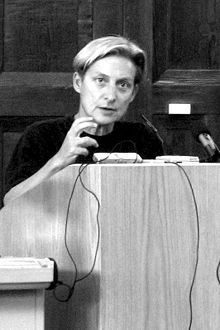
Das wird ergänzt durch die Verleihung des Adorno-Preises der Stadt Frankfurt am Main am 11. September 2012 an die amerikanische Literaturwissenschaftlerin und Philosophin Judith Butler von der University of California in Berkeley. Butler ist als antiisraelische Agitatorin weltweit berüchtigt, wenn sogar der Präsident der Harvard University im Jahr 2002, Lawrence Summers, unter anderem sie meinte als er den Hass auf Israel und die Boykottaufrufe gegen den jüdischen Staat thematisierte. Butler steht für einen Antizionismus, der sich in der Tradition von Martin Buber und Hannah Arendt verortet und die Gründung eines explizit jüdischen Staates (der zudem so tolerant ist und 20% Araber und Muslime und andere zu seiner Bevölkerung zählt) ablehnt. Mit fast vollständig homogenen islamischen Staaten wie Saudi-Arabien, Iran oder Jordanien und ihren antidemokratischen, homophoben und misogynen politischen Kulturen hat Butler selbstredend kein Problem. Die Wochenzeitung Die Zeit publizierte gar einen Text der BDS-Unterstützerin Butler und unterstützt somit den Aufruf zum Boykott Israels. Früher wäre das fast nur in der jungen Welt oder der Jungen Freiheit propagiert worden, doch längst sind solche antisemitischen Positionen Mainstream.

Eine Vertraute und Freundin von Butler, die Politikwissenschaftlerin Seyla Benhabib (Yale University) wurde 2012 in Deutschland ebenfalls geehrt. Sie erhielt am 8. Mai den Dr. Leopold Lucas-Preis der Universität Tübingen für ihren Einsatz für Hospitalität und „universelle Menschenrechte“ – auch dieser Preis ist mit 50.000€ dotiert, was ja von der schwäbischen Alma Mater freundlich ist, wenn man bedenkt, wie schlecht bekanntlich die Yale University ihre Professoren bezahlt. Benhabibs Vorbilder sind Immanuel Kant („Der Ewige Frieden“ von 1795) und Hannah Arendt. Die problematischen Aspekte dieser Art von Kosmopolitanismus oder vielmehr die anti-israelische Dimension bei Arendt,  kehren bei Benhabib verstärkt wieder. 2010 diffamierte sie Israel  indem sie es mit der südafrikanischen Apartheid und mit den „1930er Jahren in Europa“ (sie erwähnt den Slogan „Eine Nation, Ein Land, Ein Staat“ und spielt offensichtlich auf Nazi-Deutschland an) verglich – während selbstverständlich auch sie den Jihadismus z.B. der Gaza Flottille ignorierte und ihn bis heute ausblendet. Dies sind die eigentlichen Gründe für die Ehrungen und den Beifall aus Deutschland für Personen wie Butler und Benhabib. Kritik an Arendt, Kant und der europäischen Ideologie (wie sie auch Jürgen Habermas vertritt) eines Post-Nationalstaats-Zeitalter, wie sie von dem israelischen Philosophen Yoram Hazony bekannt ist, wird in Deutschland entweder gar nicht zur Kenntnis genommen oder abgewehrt.  Aufgegriffen und promotet wird sie höchstens von problematischen, nicht pro-israelischen, vielmehr deutsch-nationalen, rechten und konservativen Kreisen wie der Zeitschrift Merkur (dessen Autor Siegfried Kohlhammer den Islam mit seinen Dhimmi-Regelwerken für Nicht-Muslime schlimmer findet als den Nationalsozialismus und die Nürnberger Gesetze, und der zudem gegen Israel argumentiert).

3)     Antijudaismus.

Diese älteste Form des Antisemitismus spielt auch im nachchristlichen Zeitalter eine zunehmende Rolle. 2012 tritt ein in seiner Vehemenz seit 1945 ungeahnter und ohne Vergleich dastehender Angriff auf Juden und das Judentum auf: Hetze gegen die Beschneidung und religiöse Rituale. Alles, was Juden im Post-Holocaust Deutschland dachten, als selbstverständlich annehmen zu können, steht jetzt in Frage: Juden als Juden werden hinterfragt. Wie im Holocaust sollen männliche Juden die Hosen runter lassen, damit die arischen Deutschen nachschauen, ob er ein Jude ist oder nicht; sie durchleuchten Juden auf ihre Gesundheit, sexuellen Praktiken und Fähigkeiten und finden diese Art von Zurschau-Stellung von Juden notwendig und emanzipatorisch. Heute wird diese antijüdische Propaganda nicht unter dem Schild der SS oder der Wehrmacht durchgeführt, nein: heute geht es um „Kinderrechte“ und die angebliche Freiheit, nur als nicht-beschnittener Mann im Erwachsenenalter über die Religionszugehörigkeit entscheiden zu können.

Am 7. Mai 2012 befand das Kölner Landgericht in einem die politische Kultur in Deutschland für immer verändernden Urteil die Beschneidung von Jungen als gegen „dem Interesse des Kindes“ stehend und somit als nicht vertretbar. Die Beschneidung von jüdischen Jungen am achten Tag bzw. die Beschneidung von muslimischen Jungen im Alter zwischen 0 und 10 Jahren, sei somit nicht legal. Ein deutsches Gericht urteilt über das Judentum, das die Beschneidung vor über 4000 Jahren einführte. Der Volksgerichtshof des Nationalsozialismus hätte seine Freude gehabt an diesem 7. Mai 2012. 600 Ärzte und Juristen, angesehene normale Deutsche, agitierten sodann unter Federführung des Mediziners Matthias Franz von der Universität Düsseldorf am 21. Juli 2012 in einem Offenen Brief in der Zeitung für Deutschland (Frankfurter Allgemeine Zeitung, FAZ) gegen die Beschneidung und forderten politische und rechtliche Konsequenzen aus dem Kölner Urteil. Selbst pro-israelische Aktivisten zeigen nun ein ganz anderes Gesicht und machen sich über das Judentum lustig. Offenbar hatten diese Leute schon immer ein Israel ohne Judentum im Sinn. Die Zeitschrift Bahamas

aus Berlin folgte dem Ruf aus Köln, der FAZ und dem Zeitgeist und sprach sich gegen eine Kundgebung für Religionsfreiheit/für die Beschneidung aus und forderte ihre 23 oder 34 Anhänger auf, dieser ohnehin kleinen Manifestation vorwiegend deutscher Jüdinnen und Juden am 9. September 2012 in Berlin fern zu bleiben, da sie „den kulturellen und religiösen Traditionen von Kollektiven grundsätzlich misstraut“. Autoren dieses Sektenblattes wie Thomas Maul und Justus Wertmüller bezeichnen die Beschneidung als „archaisch“ und diffamieren dadurch mit Verve das Judentum. Derweil kringeln sich die Neonazis, die NPD und autonome Nationalisten, da doch der deutsche Mainstream das Geschäft des Antisemitismus (bis auf die Verwüstungen jüdischer Friedhöfe und von Gedenktafeln, bis heute eine typisch neonazistische Form des Antisemitismus) übernommen hat. Die Wochenzeitung jungle world 

mit ihrem Autor Thomas von der Osten-Sacken machte gegen die Beschneidung mobil und stellte Bezüge zur kriminellen Klitorisverstümmelung bei Mädchen, der Female genital mutilation (FGM), her. Sein Kollege Tilman Tarach war auf Facebook nicht weniger obsessiv dabei,

die Beschneidung und somit das Judentum zu schmähen. Eine Internetseite, Politically Incorrect (PI), die aus dem Umfeld von Parteien wie Die Freiheit, der Bürgerbewegung Pax Europa (BPE), der Pro-Bewegung und anderen Gruppierungen der extremen Rechten oder des Rechtspopulismus kommt, droht Juden:

„Wenn sich aber jüdische Verbände und Organisationen beispielsweise so an die uralte Vorschrift der Beschneidung klammern, zeigen sie damit, dass sie sich in diesem Punkt nicht vom Islam unterscheiden. So etwas können wir nach meiner festen Überzeugung in unserem Land nicht zulassen.“

Die Giordano Bruno Stiftung (GBS) mit ihrem Vorbeter Michael Schmidt-Salomon (übrigens sitzt Hamed Abdel-Samad im wissenschaftlichen Beirat der GBS),

die Deutsche Kinderhilfe, Evolutionäre Humanisten Berlin Brandenburg e.V., der Zentralrat der Ex-Muslime, die Freidenkervereinigung der Schweiz, der pflegeelternverband.de und einige andere Organisationen und Gruppen agitieren besonders aggressiv gegen Juden (und Muslime) und starten im Herbst 2012 die perfide Anzeigenkampagne

„Mein Körper gehört mir“. Zu sehen ist das Bild eines Jungen, der sich völlig verängstigt in den Schritt fasst und darunter steht: „Zwangsbeschneidung ist Unrecht – auch bei Jungen.“ Damit wird nicht nur die kriminelle und zumal islamistische Praxis der Klitorisverstümmelung mit der harmlosen Beschneidung von Jungen gleichgesetzt, vielmehr wird in Stürmer-Manier gesagt: vor allem das Judentum basiert auf Unrecht! Hieß es 1879 bei Heinrich von Treitschke „Die Juden sind unser Unglück“, was zu einem der Propagandasprüche des Nationalsozialismus avancierte, so wird im Jahr 2012 von Atheisten, Positivisten und anderen Aktivisten (die sich teils anmaßend Humanisten nennen) die Beschneidung als das Unglück für Kinder dargestellt oder Juden (und Muslime) gar als Kinderschänder diffamiert. Das liest sich wie eine post-christliche Version der Blutbeschuldigung, der antisemitischen Blood Libel.

Der Professor für Religionsgeschichte und Literatur des Judentums an der Universität Basel, Alfred Bodenheimer, ist zutiefst schockiert über den Anti-Beschneidungsdiskurs und hat im Sommer 2012 ein kleines Büchlein dazu verfasst: „Haut-Ab! Die Juden in der Besschneidungsdebatte“ (Göttingen: Wallstein). Darin analysiert er:

„Aus christlich-theologischer Sicht war die Kreuzigung ein sehr ähnliches Vergehen wie das Beschneiden der Kinder aus der heutigen säkularen: Denn die Taufe als unmittelbare Partizipation des einzelnen Gläubigen an der Kreuzigung Christi (und der damit verbundenen Sündenvergebung) machte letztlich jeden Getauften zum partiell von den Juden Gekreuzigten ­– und damit jenes Ereignisses, in dem gerade Paulus die Beschneidung aufgehoben hatte. Der säkulare Ausgrenzungsdiskurs folgt dem christlichen auf dem Fuße, er ist kultur- und mentalitätsgeschichtlich so leicht abrufbar, dass insbesondere den dezidierten Säkularisten die Ohren sausen dürften, wären sie sich der Sensoren gewahr, die ihren Furor geweckt haben. Der säkularistische Anspruch, Gleichheit in allen Belangen zur Ausgangslage eines frei auslebbaren Individualismus zu machen, trägt mehr vom Paulinischen Universalismus in sich (dessen Gegenbild die auf defensiver Differenz bestehenden Juden waren), als dem Gros seiner Vertreter klar ist.“ (ebd., 58f.)

Die Internetseite HaOlam mit ihrem Vertreter Jörg Fischer-Aharon, die sich jahrelang als pro-israelisch gab, hat den Anti-Beschneidungsvorkämpfer Schmidt-Salomon exklusiv interviewt und macht damit Werbung für obige Anzeigenkampagne.

Manche Organisationen, die häufig mit HaOlam bzw. deren Umfeld und vielen anderen aus der nie näher definierten „pro-Israel-Szene“ kooperierten, werden ins Grübeln kommen.

Sei es Ressentiment auf Religion oder kosmopolitisch inspirierte Universalität, jedenfalls wird mit bestem Gewissen jedwede Partikularität – wie die des jüdischen Staates Israel und des Judentums, inklusive seiner religiösen Traditionen, die auch von nicht-gläubigen Juden mit überwältigender Mehrheit praktiziert werden – abgelehnt.

Es ist unerträglich, mit welcher Arroganz, Obszönität und Dreistigkeit ausgerechnet deutsche Areligiöse,  Christen, selbsternannte Israelfreunde und „Antifas“ sich de facto zu den islamistischen und neonazistischen Judenfeinden gesellen und völlig geschichtsvergessen das Nachdenken einstellen.

Kaum jemand hat heute in Deutschland noch Beißhemmungen wenn es um Juden geht.

Dieser hier skizzenhaft aufgezeigte neu-alte Antisemitismus zeigt sich in dramatischer Form in vier antisemitischen Vorfällen in wenigen Wochen bzw. Tagen allein in Berlin:

  • Am 28. August 2012 wurde in Berlin-Friedenau am helllichten Tag der Rabbiner Daniel Alter von mehreren vermutlich arabischen Jugendlichen und Antisemiten krankenhausreif geschlagen. Er trug eine Kippa und wurde gefragt, ob er Jude sei. Das „Ja“ führte zu einem Jochbeinbruch und Todesdrohungen gegen seine 6-jährige Tochter. Die Täter sind bis heute nicht ermittelt.
  • Am 3. September wurde gegen 10 Uhr vormittags eine Gruppe von jüdischen Schülerinnen vor der Carl-Schuhmann-Sporthalle in der Schlossstraße in Berlin-Charlottenburg von vier ca. 15-16-jährigen Mädchen muslimischer Herkunft (eine der Antisemitinnen trug ein Kopftuch) diffamiert und u.a. als „Judentussen“ beleidigt.
  • Am höchsten jüdischen Feiertag, Yom Kippur, am Mittwoch, den 26. September 2012, rief Esther Dobrin aus Berlin gegen 11 Uhr ein Taxi, um mit ihrer 11-jährigen Tochter und zwei weiteren Personen zur Synagoge in die Pestalozzistraße zu fahren. Der Taxifahrer verhielt sich reflexhaft feindselig, als der genaue Bestimmungsort als „Synagoge“ benannt wurde; er warf die vier Fahrgäste sozusagen aus dem Wagen.
  • Wenig später, gegen 18 Uhr an diesem 26. September, wurden drei andere Juden in Berlin verbal attackiert. Der Generalsekretär des Zentralrats der Juden in Deutschland, Stephan Kramer, kam gerade mit seinen beiden Töchtern im Alter von 6 und 10 Jahren von der Synagoge, ebenfalls in Charlottenburg, unweit des Kurfürstendamms, als er offenbar wegen eines klar ersichtlichen jüdischen Gebetsbuches beleidigt wurde. Im Laufe eines aggressiven Wortgefechts hat Kramer nicht nur die Polizei zu Hilfe gerufen, vielmehr auch auf seine Waffe gezeigt, die er seit acht Jahren zum Selbstschutz und als ausgebildeter Sicherheitsbeauftragter bei sich trägt. Die Polizei hat nun zwei Anzeigen zu bearbeiten, Kramer zeigte die Beleidigungen des Antisemiten an, während derselbe Kamer wegen Bedrohung anzeigte, wozu er, nach unbestätigten Informationen,  von der Berliner Polizei durchaus ermutigt worden war.

Kramer kennt die Zusammenhänge des GraSSierenden Antisemitismus in Deutschland und weiß, dass sich die geistigen Zustände und Debatten in gewalttätigen Straßenantisemitismus entladen können – darum ist er bewaffnet. Welche zwei komplett disparaten Lebensrealitäten – eine jüdische und eine nicht-jüdische – werden von nichtjüdischen Deutschen tagtäglich stillschweigend hingenommen? Wie fühlt es sich an, ständig in den Einrichtungen der eigenen Religion/Gruppe, Kindergarten, Schule, Synagoge etc. unter Polizeischutz stehen zu müssen?

1925, einige Jahre vor NS-Deutschland, im demokratischen Rechtsstaat der Weimarer Republik passierte in Stuttgart Folgendes:

„An einem Sonntag im November 1925 las der Kaufmann Ludwig Uhlmann in der Gastwirtschaft Mögle Zeitung und trank ein Bier. In provozierender Absicht beleidigte ihn der am Nachbartisch sitzende Franz Fröhle mit spöttischen Bemerkungen und ließ mehrfach die Bezeichnung ‚Jude Uhlmann‘ fallen. Dieser reagierte nicht. Daraufhin sagte Fröhle: ‚Was will der Judenstinker hier, der Jude soll heimgehen‘, was Uhlmann sich verbat. Als die Pöbeleien anhielten, zog Uhlmann eine Pistole, mit der Bemerkung, dass Fröhle damit Bekanntschaft machen könne, falls er nicht aufhöre. Schließlich setzten der Wirt und die Polizei den Beleidiger vor die Tür. Die Staatsanwaltschaft beantragte nicht nur einen Strafbefehl gegen Fröhle wegen Beleidigung in Höhe von 50 RM Geldstrafe, sondern auch einen gegen Uhlmann wegen Bedrohung und abgelaufenen Waffenscheins. Bei der Hauptverhandlung des Amtsgerichts wurde er zwar von der Anklage der Bedrohung freigesprochen, aber wegen der Bagatelle des abgelaufenen Waffenscheins von wenigen Monaten zu einer Geldstrafe von 30 RM verurteilt.“ (Martin Ulmer (2011): Antisemitismus in Stuttgart 1871–1933. Studien zum öffentlichen Diskurs und Alltag, Berlin: Metropol, S. 350)


Dieses Schlaglicht zeigt die Normalität antisemitischer Beleidigungen, die in der deutschen politischen Kultur bereits damals, wie sich an unzähligen Beispielen aufzeigen lässt, tief verankert und sedimentiert war.

Heute nun, im Jahr 2012, über 67 Jahre nach dem Holocaust und Auschwitz – welch ein Unterschied ums Ganze! –, müssen sich Juden wieder bewaffnen. Sie sind fast täglich Angriffen, Beleidigungen und Hetzkampagnen ausgesetzt und es kann sich eine Szene abspielen, die der in einer Stuttgarter Kneipe von 1925 gruselig ähnelt.


Auf der einen Seite haben wir diese Vorfälle aus dem Jahr 2012 und insbesondere die „Beschneidungsdebatte“ mit all ihren antisemitischen Internet-Kommentaren -und Forenbeiträgen, die einen an Max Liebermanns Ausspruch zum 30. Januar 1933 denken lassen. Auf der anderen sucht man vergebens die arrivierten Antisemitismusforscherinnen und -forscher, die sich der skizzierten Forschungsfelder annehmen. Werner Bergmann schrieb 2011 in einer Festschrift für einen Kollegen:

„Im historischen Vergleich mit der Zeit vor 1945, aber auch in den letzten 60 Jahren in Deutschland […] war Antisemitismus gesamtgesellschaftlich wohl selten so sehr an den Rand gedrängt wie heute.“

Antisemitismus ist in Deutschland nicht erst, aber insbesondere im Jahr 2012 gesamtgesellschaftlich so weit verbreitet wie vielleicht noch nie seit 1945.


Susanne Wein ist Historikerin und promovierte im September 2012 an der Freien Universität Berlin  mit einer Arbeit über „Antisemitismus in der politischen Kultur der Weimarer Republik. Eine Untersuchung anhand der Debatten im Reichstag“.

Clemens Heni ist Politikwissenschaftler und promovierte im August 2006 an der Leopold-Franzens-Universität Innsbruck mit einer Arbeit über die „Salonfähigkeit der Neuen Rechten. ‚Nationale Identität‘, Antisemitismus und Antiamerikanismus in der politischen Kultur der Bundesrepublik Deutschland 1970 – 2005: Henning Eichberg als Exempel“.

Pro-Circumcision Rally Held in Berlin, German Activists Seek a “Fantasy Israel with no Judaism”

Algemeiner.com, September 12, 2012

On Sunday, September 9, 2012, the first ever pro-circumcision and Jewish (and Muslim) life rally in Germany, was held in Berlin. In May 2012 a Cologne court ruled against a Muslim circumcision and generalized that the rights of children are threatened by every single circumcision, regardless at what age it is made.

This is probably the most hardcore attack by a first world country against the practice of Brit Milah and Jewish life in recent decades. Jews and Muslims are extremely irritated, sad, and frightened.

At the event, in downtown Berlin, one of the rabbis openly said that circumcision, the Brit Milah, is seen by Jews as a connection with god, and is among the observances that almost all Jews, regardless if they are true believers, orthodox, liberal, agnostic, non-believing, atheist or whatever, practice. At the rally he said that over 90% of Israeli male Jews are circumcised and that it is an essential part of Israeli and Jewish identity.
Interestingly, the German activists behind the anti-circumcision fervor, actually believe they are being seen as pro-Israel, but their Israel is a fantasy Israel with no Judaism.

Some 300 people joined the rally, orthodox rabbi Yitzchak Ehrenberg as well as liberal Rabbi Tovia Ben-Chorin spoke, united on the podium. The event was organized by the Berlin based Forum for Democracy and against Antisemitism (JFDA), lead by former head of the Jewish Community of Berlin, Lala Süsskind, and her colleague Levi Salomon. They are both known for their tireless efforts to fight against all forms of anti-Semitism.

A few weeks ago, they organized another rally against the anti-Zionist and anti-Semitic al-Quds day, an Iranian propaganda event to denounce Israel and its capital, Jerusalem. At the rally to protect circumcision, the head of the (liberal) Turkish Community in Germany, Kenan Kolat, spoke as well in support of the Jewish fight against the anti-circumcision climate in Germany. A young German-Turkish actor gave his first speech ever, because he was so upset about the discussion in Germany.
Earlier, organizations like the Giordano-Bruno Foundation (known for their work against Islamism, too) announced that they are going to launch a campaign later this month to attack circumcision and to fight for the “rights of children,” and against the decision-making of parents vis-à-vis the Brit Milah. Jews are accused of abusing children, in effect, if not intent. This is a new form of blood libel, framed in nice German words, always suggesting that Germans love children. In fact many Germans hate Jews and Judaism and some do not like children either. These worrying developments provided the backdrop for the important rally.

Several Israeli flags were displayed at the event, too. However, compared with a rally just a week ago prompted by an anti-Semitic attack against a rabbi on the streets of Berlin by (according to eye-witnesses) German-Arab-Muslim youngsters, where some 1500 people, many Christians among them, showed up, the 300 people were a small group.

The very same Christians and liberal Germans who always love to pretend to be open-minded and pro-Jewish, dislike Judaism as soon as it comes to circumcision. The political elite in Germany did not show up at the event, with the exception of one social democratic Member of Parliament, who did not join the rally in his political function as vice President of the German Bundestag, rather as an individual. This speaks volumes.

In recent weeks there has been a huge debate over circumcision in many parts of German society. Right-wing extremists like those writing for the website Politically Incorrect (known for its support of groups like the party Die Freiheit, the Bürgerbewegung Pax Europa, the so called Pro-Germany movement and the campaign “Stop the left” or “Linkstrend stoppen”) said that Jews will not have a place in Germany if they keep on practicing circumcision. 600 mainstream doctors and others published a letter in leading conservative daily, the Frankfurter Allgemeine Zeitung, arguing against circumcision. Others, like marginal left-winger and NGO-activist (in Iraq and the Middle East) Thomas von der Osten-Sacken, equated Brith Milah more or less with female genital mutilation (FGM). They’ve lost perspective and run riot.

It is also interesting to note that the very same people who have opposed the anti-Zionist Judith Butler, who will be awarded the prestigious Adorno-Prize on September 11, 2012, in the city of Frankfurt, now attack Judaism and the Brit Milah. Their opposition to anti-Zionism contradicts their anti-Jewish feelings (framed as pro-child ideology).

A tiny journal in Berlin, called Bahamas, closely related to the publishing house Ça ira, has pretended to be pro-Israel in recent years. They publish articles against Islamism, anti-Semitism and hatred of Israel. However, they urged their readers and followers in a short statement on September 4 not to join the pro-circumcision rally because they detest “religious traditions.”

They support Israel but have an Israel in mind without circumcised Jews. Maybe they just want a female Israel with a few un-circumcised gentiles?

The Bahamas journal is not favored by Anti-Zionist Germans and the German state. However, self-declared friends of Israel seem to like the publication, despite its urging of its followers not to join a Jewish (and Muslim) rally to protect Judaism, Jewish tradition and circumcision. Bahamas was not just silent about the pro-circumcision rally. They were so outraged about this Jewish practice that they urged their “friends of Israel” not to participate in the event. Non-Jewish Germans explaining what it really means to be pro-Israel. That’s fun.

Laudatio für Judith Butler wird von einer antiamerikanischen Verharmloserin des Nationalsozialismus und des Holocaust gehalten: Eva Geulen

Von Dr. Clemens Heni

The Berlin International Center for the Study of Antisemitism (BICSA)


Am 11. September 2012 wird der Adorno-Preis der Stadt Frankfurt verliehen. An diesem Tag im Jahr 1903 wurde Theodor W. Adorno geboren. Was liegt nun näher, für ganz normale Deutsche, als an diesem Tag, dem 11. Jahrestag des islamistisch motivierten Massenmordes von 9/11, eine antiamerikanische, den Holocaust und den Nationalsozialismus verharmlosende Frau die Laudatio auf die Israelhasserin Judith Butler, die sich als zärtliche Freundin von Seyla Benhabib, Martin Buber und Hannah Arendt vorstellt und Israel im Sinne eines (deutsch-jüdischen) „kulturellen Zionismus“ zerstört wissen möchte, halten zu lassen?

Eva Geulen heißt die Laudatorin


und in meinem Buch Schadenfreude. Islamforschung und Antisemitismus in Deutschland nach 9/11 schrieb ich über sie.


Sie hat ein Büchlein zur Einführung in das Denken des italienischen Philosophen Giorgio Agamben geschrieben. Darin wendet sie sich wie der modische Vorzeigeverniedlicher des Nationalsozialismus im Suhrkamp-Verlag gegen „biopolitische Interventionen im Alltag“ und findet es total angemessen mit der „Auschwitz-Insinuation“ herum zu fuchteln. Daher schrieb ich also im August 2011:

2004 wurde deutlich, wie Antiamerikanismus, eine Verharmlosung des Antisemitismus sowie die Rede vom ubiquitären ‚Lager‘ bei Agamben jeglichen Realitätsbezug vermissen lassen. Denn ein Buch der Literaturwissenschaftlerin Eva Geulen[i] zur Einführung in das Denken Agambens stellt sich unverhohlen hinter diesen modischen, antimodernen und antisemitischen Vordenker. Es ist eine typische Antwort heutiger Gegenintellektueller auf den Islamismus und den 11. September. Ein Gegenintellektueller ist in der Tradition der Mandarine zu sehen, also der früheren chinesischen Berater des Kaisers. Gegenintellektuelle wenden sich gegen Herrschaftskritik und Gesellschaftsanalyse im aufklärerischen Sinn, eher stehen sie für Gegenaufklärung und Restauration.[ii] Viele Wissenschaftler und von der Öffentlichkeit als „Intellektuelle“ wahrgenommene Personen sind eher Gegenintellektuelle, so kritisch sie sich auch gerieren mögen. Ein antiwestliches Ressentiment ist häufig grundlegend, so etwa die Diffamierung der USA als eine Art ‚Nazi-Land‘ bei Agamben; seine Verteidigerin Eva Geulen kokettiert damit:

„Viel Ärger und viel Lob hat sich Agamben eingehandelt, als er unter skandalträchtigem Verweis auf die Tätowierung von KZ-Häftlingen im Frühjahr 2004 eine Gastprofessur an der New York University nicht antrat, weil er sich exemplarisch und öffentlich der von den USA nach den Terroranschlägen am 11. September 2001 von allen Einreisenden verlangten Abnahme eines DNA-Fingerabdrucks verweigerte (wer im Besitz einer green card ist, hat ihn längst hinterlegt). (…) Ihm einen direkten Vergleich zwischen der Immigrationszone des New Yorker Kennedy-Flughafens und einem Konzentrationslager zu unterstellen ist offensichtlich verfehlt. Schockiert könnte man sich aber darüber zeigen, dass wir uns an biopolitische Interventionen im Alltag offenbar schon so sehr gewöhnt haben, dass es der Auschwitz-Insinuation bedarf, um die Lethargie zu unterbrechen. Was in solchen Räumen geschieht, ist nicht mehr rechtlich abgesichert, sondern hängt ‚von der Zivilität und dem ethischen Sinn der Polizei‘ ab, die vorübergehend in solchen Räumen als Souverän agiert.“[iii]

Es ist antisemitisch, eine Kontinuität von den Lagern und den KZs hin zu vergleichsweise harmlosen DNA-Fingerabdrücken im 21. Jahrhundert zu imaginieren. Letztere sind zudem als Reaktion auf den von Islamisten verübten Massenmord im World Trade Centereingeführt worden. Die Forschung redet jedoch lieber von „Bio-Politik“ statt von antimodernem Islamismus.

Wurde das Gedenken an Theodor W. Adorno jemals so sehr in den Dreck gezogen wie am 11. September 2012 in Frankfurt am Main in der Paulskirche? Das deutsche Establishment, nicht nur Axel Honneth und Micha Brumlik, wird klatschen und innerlich johlen und frohlocken ob soviel Antisemitismus, Hass auf Amerika und Israel, Banalisierung von Auschwitz und Abscheu vor Theodor W. Adorno.


[i] Geulen ist Professorin am Institut für Germanistik, Vergleichende Literatur- und Kulturwissenschaft, Abteilung für Neuere deutsche Literaturwissenschaft der Universität Bonn, http://www.zfkw.uni-bonn.de/zentrumsrat/mitglieder/profile/geulen.html (21.02.2011).

[ii] Zum Begriff des Gegenintellektuellen vgl. Heni 2007, 87–89.

[iii] Eva Geulen (2005): Giorgio Agamben zur Einführung, Hamburg: Junius, 101. Auch an anderer Stelle verharmlost die Autorin selbst den Nationalsozialismus, wenn sie in Anlehnung an Agamben die „Schutzhaft im Nationalsozialismus“ mit der Situation „der Gefangenenlager in Guantanamo Bay“ gleichsetzt und jeweils als „Ausnahmezustand“ bezeichnet (vgl. ebd., 96f.); Letzteres ist eine Begrifflichkeit des Nazijuristen Carl Schmitt, einer Referenzquelle Agambens.


Center for Research on Antisemitism (ZfA) in Germany appointed anti-Israel activist

Islamic Studies scholar Achim Rohde
promotes Edward Said and
anti-Zionist antisemitism


By Dr. Clemens Heni, The Berlin International Center for the Study of Antisemitism (BICSA), August 1, 2012 (another version of this article was published July 31, 2012, with algemeiner.com in New York City)


The Center for Research on Antisemitism (ZfA) at the Berlin Technical University in April 2012 appointed as a co-worker an outspoken supporter of antisemite Edward Said: Achim Rohde. A scholar in Islamic Studies, Rohde was hired because he conducts research to evaluate the similarities of “antisemitism” and “Orientalism” “in the sense of Edward Said,” as the ZfA newsletter of May 2012 declares. In addition, he will be working on the ZfA’s big project on “Islamophobia in European societies.”[1] “Islamophobia” as a research project of a Center for Research on Antisemitism? This is unscholarly in nature and politically scandalous.

The appointment of Achim Rohde is shocking for scholars on antisemitism, though a big coup for enemies of the Jewish state of Israel. Responsible for this is newly appointed head of the ZfA, historian Stefanie Schüler-Springorum. Hired in June 2011, she is a newcomer to scholarship on antisemitism. She has not published a single book on that topic – nor has Rohde.

Edward Said becomes even more mainstream
in German academia

Edward Said (1935–2003) was the leading academic anti-Zionist voice in the last decades, achieving global fame. He portrayed Arabs as the ‘new Jews’ as early as 1969.[2] He equated Israel with South-African apartheid in 1979[3] and portrayed Israel as the leading Orientalist, imperialist and racist power in his bestselling book Orientalism in 1978.[4] The chapter on Israel is the last and longest chapter in this anti-Western and antisemitic book. In an interview in 1987 Said said that Israelis had not learned the lessons from their own suffering under Nazi Germany. In his view Jews have become perpetrators now in the same way Germans or Nazis were perpetrators against the Jews.[5] In 1999 Said said that, if he could choose, he would opt for a kind of renewed Ottoman Empire. Jews could become an accepted minority, but Israel would be destroyed.[6]

Now, in 2012, Edward Said is mainstream[7] at the only German University based research center on antisemitism. They are promoting antisemitism instead of analyzing it.

Achim Rohde and the equation of antisemitism
and Orientalism

Rohde was published in 2010 by then head of the ZfA, controversial historian Wolfgang Benz.[8] Rohde promotes the fantasy that Muslims and Arabs had been victims of Germany since the 19th century, if not long before. He follows the ideology of “the Orient within.” This means: while Orientalists aim at Arabs and Muslims in the Middle East, they aim at Jews in Europe. Jews are victims of Orientalism within the homeland of the empire, Europe, so to speak, while Arabs and Muslims are victims abroad, in the Middle East and in the fantasies of artists, authors, writers, politicians, intellectuals, the public, art historians, painters etc. etc.

This equation of antisemitism and Orientalism is a denial of antisemitism, which is based on conspiracy theories, blood libels, anti-liberalism, anti-capitalism, anti-communism, anti-Westernism and many other aspects of that “longest hatred,” a term of historian Robert S. Wistrich.[9] The “lethal obsession” (Wistrich)[10] of antisemitism cannot be compared or equated with supposedly or real Orientalism and allegedly or really problematic views vis-à-vis the Arabs and Muslims. Particularly after 9/11 it has become fashionable and useful to ignore Islamism and Muslim antisemitism and to talk about Arabs, Muslims and Jews as victims of Orientalism. Anti-Zionist antisemitism is a core element of this post-Orientalist ideology, as I have shown in the work of Edward Said.


Rohde and many colleagues, who are obsessed with post-colonial ideology and Edward Said, ignore or deny the close friendship of German Emperor Wilhelm II, who traveled to the Ottoman Empire in 1898 and portrayed himself as friend of the Muslims. German Islamists remember this German-Muslim friendship until today.[11] In 1914, during the First World War, Wilhelm II initiated the Jihad of the Ottoman Empire, as Middle East Studies scholar and historian Wolfgang G. Schwanitz has shown.[12] Subsequently, the Arab Muslim Brotherhood developed close ties with the Nazis even before the Holocaust. During the Shoah, the Arab and Muslim leader at the time, Haj Amin al-Husseini, Grand Mufti of Jerusalem, collaborated with Hitler and the Germans. Nazi Germany was pro-Arab and pro-Muslim, and anti-Jewish.[13] Holocaust survivor Simon Wiesenthal documented the close relationship of the Grandmufti of Jerusalem, al-Husseini, and the Axis (Nazi Germany and fascist Italy) in 1947.[14]


Nazi scholar Hans Lindemann published a work about Islam in 1941, urging the Germans to see the similarities of the Muslim world and National Socialism.[15] A leading Nazi agitator, Johann von Leers, was happy about Islamism and converted to Islam after the defeat of Nazi Germany and went to Egypt, like many former Nazis, to spread Jew-hatred and antisemitism in that leading Arab country. Egyptian President Nasser welcomed these Nazis and collaborated with them, as the American Jewish Committee documented as early as 1957.[16] Historian Robert Wistrich analyzed the antisemitism of Egypt and von Leers in 1985.[17]

During the 1950s, the Federal Republic of Germany became a hotbed for Islamism (supported by Federal agencies), thanks to anti-communist hysteria of the time, as Pulitzer Prize winner Ian Johnson[18] and historian Stefan Meining[19] have shown in recent years. Finally, 9/11 inflamed German Schadenfreude, anti-American, anti-Israel and pro-Islamist tendencies.[20]

Rohde, from the younger generation (born 1969), is equally aggressive against critics of antisemitism as is Benz. Rohde’s thesis was about the Ba’ath Party, Saddam Hussein, gender-relations in Iraq, and the ideology of pan-Arabism.[21] He submitted his work in 2006 at the Institute for Islamic Studies at Free University Berlin. His first reader was the controversial (in Germany: prize winning) scholar Gudrun Krämer, who is known for portraying the founder of the Muslim Brotherhood, Hasan al-Banna, as a nice guy with great ideas to promote Islam.[22] She is also known for her support of the leading Sunni Islamist in the world, Yusuf al-Qaradawi,[23] who praised Adolf Hitler in January 2009 in Al-Jazeera TV, aired from Qatar, where he lives.[24]

For Rohde, Iraq Ba’ath party style pan-Arabism failed. He urges the Arab world to look for a stronger and more successful way of pan-Arab ideology and action.[25] He is against the “hegemony of globalization”[26] and refers to Edward Said, Daniel Boyarin and anti-Zionist Jacqueline Rose.[27] Why did Rohde refer to anti-Zionist and antisemitic authors in a doctoral dissertation dedicated to the analysis of Iraq, gender relations and pan-Arabism?

Boyarin and Rose have been analyzed as examples of progressive Jewish antisemitism by scholar in literature and Jewish Studies Alvin H. Rosenfeld in 2006.[28] It is telling that Rohde deleted these references at the very end of his study to Boyarin,[29] Rose and Said in his published book in 2010 on the same topic.[30]

Rohde refers to German historian Jürgen Zimmerer, a leading voice in distorting the Holocaust by universalizing it and framing colonial crimes as forerunners of the Shoah. For Rohde, imperialism, racism, and Orientalism are closely related to Nazi Germany.[31] He also compares German and Nazi “sexual politics” with those of the United States and Israel in the 20th century.[32]

The ZfA, Hazem Saghiyeh and Saleh Bashir and the Universalizing of the Holocaust

Achim Rohde is not a direct Holocaust denier; instead he trivializes and distorts the Shoah by referring to Arab authors like Hazem Saghiyeh and Saleh Bashir. Saghiyeh and Bashir published an article in 1997 in which they argued against Holocaust denial, characterizing it as too stupid an argument to be useful in their fight against Zionism.[33] Indeed, even Said is against hard-core Holocaust denial, but he said in the very same article Rohde refers to that “Zionism” is based on “apartheid.”[34]

The same holds for the article Universalising the Holocaust by Hazem Saghiyeh and Saleh Bashir.[35] They accused Israel of not having learnt the lessons from history; they distorted and trivialized the Shoah completely by equating it with racism and colonialism:

“The dissociation between the acknowledgment of the Holocaust and what Israel is doing should be the starting point for the development of a discourse which says that the Holocaust does not free the Jewish state or the Jews of accountability. On the contrary, the Nazi crime compounds their moral responsibility and exposes them to greater answerability. They are the ones who have escaped the ugliest crime in history, and now they are perpetrating reprehensible deeds against another people. Modern Jewish consciousness can no longer look at the world from the exclusive perspective of the Holocaust, in spite of the magnitude of the event and its enormity. Within these parameters, it becomes pressing to (re)present the event as a trial for human suffering more than a purely and exclusively Jewish one, especially since the Jews in recent decades have started losing their long-standing “monopoly” over the tragic. The Turk in Germany, the Algerian in France, and always the black in every place, head the columns of victims of racism in the world and in them, albeit in different proportions and degrees, is the continuation of the suffering of the Jews of which the Holocaust was the culmination.”[36]

This antisemitic argumentation which universalizes the Holocaust and therefore trivializes it is a basic assumption of Islamic Studies scholar Achim Rohde. For him, like for Saghiyeh and Bashir, Turkish, Algerian or Black people are seen in a “continuation of the suffering of the Jews of which the Holocaust was the culmination.”

This is a denial of the Holocaust if we look at the situation of Turks in Germany or Arabs and Algerians in France at any time. It is unscholarly in nature to equate the situation of immigrants or citizens with an immigrant background and the Holocaust.

In an article in 2005, Rohde thanks[37] anti-Zionist authors Moshe Zuckermann from Israel and German sociologist and anti-Zionist Klaus Holz“[38] for helpful comments and support. Holz was on the short-list for the job as head of the ZfA and Zuckermann knows Schüler-Springorum, too.[39]

For Rohde Zionism is based on „central aspects of modern antisemitism;” for him it is „a kind of identification with the aggressor.”[40] He attacks Israel and remembrance of the Shoah in Israel and urges the Arab and Muslim world not to deny the Holocaust, but to attack “Shoah remembrance in Israel”[41] from a ‘higher ground.’ This ‘higher ground’ is the distortion or trivialization of the Holocaust and not hard-core denial of it.

Achim Rohde and the campaign in support of German anti-Zionist Ludwig Watzal

In December 2008 Rohde supported an Internet campaign by a German anti-Israel and antisemitic website in support of German political scientist and anti-Zionist activist Ludwig Watzal.[42] Secretary General of the Central Council of Jews in Germany, Stephan Kramer, attacked the “antisemitic clichés” of Watzal in April 2008. Then, the Central Council of Jews in Germany pleaded to dismiss Watzal as co-worker of a Federal Agency.[43] Political scientist and expert on Islamism, Iran, and antisemitism, Matthias Küntzel, criticized Watzal in 2005 as well.[44]

In his support of Watzal, Rohde was joined by Palestinian Abdallah Frangi, Ramallah, from the PLO, antisemitic author Norman Finkelstein, left-wing politician Inge Höger, who joined the terrorist Gaza flotilla in 2010 (she was on the Mavi Marmara), and over 300 other anti-Zionist activists, scholars etc. Watzal is a particularly aggressive anti-Zionist voice in Germany. Due to many of his anti-Israel articles, critics like Social Democrat Franziska Drohsel, then head of the youth organization of the Social Democrats in Germany (Jusos), supported Jewish organizations who urged the Federal Agency for Education to take a clear stand against their co-worker Watzal. German daily Die Welt reported about the anti-Israel stand of Watzal.[45] While ZfA co-worker Achim Rohde supported Ludwig Watzal in 2008, even his colleague at the ZfA, Juliane Wetzel, criticized Watzal’s writing and his fantasies about “Jewish capital” and “Jewish power,” according to an article in 2006.[46]

Rohde, Gil Anidjar and poststructuralist,
linguistic Holocaust denial:
Jews were not killed as Jews in Auschwitz…

Rohde also sides with Middle East Studies scholar Gil Anidjar from Columbia University and his study The Jew, The Arab. A History of the Enemy from 2003,[47] because Anidjar equates antisemitism with Orientalism and portrays Muslims as victims of Nazism and the Holocaust.[48] For Anidjar, Zionism is antisemitic, because it aims at Judaism, Jews, Arabs, and Islam. He applies Said’s ideology of the “Semite” and accuses “Orientalism” of being antisemitic, including being anti-Arab.[49] This is a denial of antisemitism, of its term and ideology. Islam has a legacy of antisemitism, although on another level as Christian antisemitism. Portraying Muslims and Arabs as victims of European history is beyond reality. Islam is an imperialist religion, like Christianity. For centuries, Jews have been oppressed and murdered by Christians and also by Arabs and Muslims (on a lower scale). Since 1945 and particularly since 9/11 Islamism and Arab anti-Zionism are the biggest threat to Jews and Israel. Iran seeks nuclear weapons and its president Mahmoud Ahmadinejad is known for his incitement to genocide; he pleads for a “World without Zionism,”[50] and is followed by the entire Iranian regime and substantial parts of Western academia and activists as well. Edward Said fought for a world without Zionism, too, decades before Ahmadinejad, and even before the Iranian revolution in 1979.


Anidjar makes fun of Jews and the Holocaust and equates the fate of Jews with the history of the word “Muslim.” For him, like for fashionable Italian philosopher Giorgio Agamben Jews died as “Muslims” and not as Jews in Auschwitz.[51] This is linguistic antisemitism. These horrible games with language are mainstream in many poststructuralist, postmodern and antisemitic circles. It is shocking, though, that a scholar from the ZfA refers favorably to this parody of scholarship.


In reality Muslims were allies of the Nazis, we know of SS-Imams, Muslims in the German army, the Wehrmacht, SS-units and so on. Rohde follows Anidjar and says that both Jews and Muslims have been victims of Europe since the crusades.[52] In an interview about his book Anidjar rejects any scholarly analysis of the “new antisemitism” and equates antisemitism with racism or the situation of Muslims.[53] In 2009 Anidjar published another article and equated (and mentioned the “link” between) colonialism and the Holocaust;[54] he attacked Israel, the US and the War on Terror, in order to portray the poor and innocent Arabs (and Muslims) as victims of Israel and the US.[55] Already in his 2003 book and then in his 2009 article, Anidjar applied the grotesque distinction between “The Jew, the Arab: good Semite, bad Semite.”[56] Like Edward Said and many protagonists of post-colonial theory, he denies that antisemitism was an anti-Jewish ideology from the very beginning (and not a kind of Orientalism), starting with Wilhelm Marr’s agitation in Germany in 1879.[57] Consequently, Anidjar was a speaker in 2009 at the Israel Apartheid Week and promoted boycotting Israel and therefore Jews.[58] This is no problem and not worth mentioning for German academics like Achim Rohde or Felix Wiedemann, also a scholar from the younger generation; as quoted, Achim Rohde referred to Anidjar very positively in 2005 as well as in 2010, Wiedemann refers to Anidjar’s scandalous book from 2003 (The Jew, The Arab) in 2012, and promotes Rohde’s approach, too, embedded in esoteric, cotton-ball-style criticism.[59]

Conclusion

What is the problem with Achim Rohde’s appointment to Germany’s premier, tax-supported Center for Research on Antisemitism (ZfA) at Technical University in Berlin?


1) He supports antisemitic, anti-Zionist, post-colonial and post-Orientalist superstar Edward Said;

2)  He supports German anti-Zionist and highly controversial activist Ludwig Watzal;

3) He supports antisemitic, anti-Zionist authors like Daniel Boyarin and Jacqueline Rose;

4) He supports authors who make fun of the Jewish victims of the Holocaust, who defame Israel as apartheid and promote the boycott of Israel like Gil Anidjar;

5) He supports the trivialization and in fact denial of the Holocaust by equating it with the situation of Turks in Germany today with reference to Hazem Saghiyeh and Saleh Bashir;

6) He equates antisemitism with “Orientalism” and denies the genocidal ideology of antisemitism;

7) He ignores or affirms the Iranian and Islamist threat;

8) He dwells on the fantasy of “Islamophobia” and is employed to do so by the ZfA.


The Center for Research on Antisemitism (ZfA) at the Technical University Berlin should finally change its name: it is


The German Edward Said Center for
Holocaust distortion
and post-colonial Antisemitism


[1] Newsletter, No. 42, Center for Research on Antisemitism (ZfA), Technical University Berlin, May 2012, http://zfa.kgw.tu-berlin.de/newsletter/Newsletter42.pdf (visited July 21, 2012).

[2] Edward Said (1969): The Palestinian Experience, in: Moustafa Bayoumi/Andrew Rubin (eds.) (2001), The Edward Said Reader, London: Granta Books, 14–37, 34.

[3] Edward Said (1979): Zionism from the Standpoint of its Victims, in: Bayoumi/Rubin (eds.) (2001), 114–168.

[4] Edward Said (1978): Orientalism, New York: Vintage Books.

[5] The interview reads: “[Question to Said] Given the history of the Jews and the creation of the Israeli state, because of their historical experience with persecution and suffering and holocaust [small ‚h’ in the original, CH] and death camps, should one feel that Israelis and Jews in general should be more sensitive, should be more compassionate? Is that racist? [Said] No, I don’t think it’s racist. As a Palestinian I keep telling myself that if I were in a position one day to gain political restitution for all the suffering of my people, I would, I think, be extraordinarily sensitive to the possibility that I might in the process be injuring another people“ (Edward Said (1987)/2010: The Pen and the Sword. Conversations with Edward Said. David Barsamian, introductions by Eqbal Ahmad and Nubar Hovsepian, Chicago: Haymarket Books, 42).

[6] Edward Said (1999): An Interview with Edward Said, in: Bayoumi/Rubin (eds.) (2001), 419–444, 430.

[7] In Cultural Studies, Islamic Studies, Middle East Studies, comparative literature and related fields, Said has been mainstream for a long time. See, for example, among his followers in Germany Markus Schmitz (2008): Kulturkritik ohne Zentrum. Edward W. Said und die Kontrapunkte kritischer Dekolonisation, Bielefeld: transcript (Schmitz defames the Middle East Forum’s project Campus Watch and says it is a reminder to the times of “McCarthy,” ibid., 227); Stefan Wild (2003a): Rezension von Martin Kramer, Ivory Towers on Sand. The Failure of MiddleEastern Studies in America, Washington D.C. 2001, ISBN 0-94 4029-49-3, 130 S., U.S. $ 19,95, Die Welt des Islams, Vol. 43, Nr. 2, 290–292 (this is a particularly aggressive and ironic review of Martin Kramer’s famous study Ivory Towers on Sand from 2001); Birgit Schäbler (2008): Post-koloniale Konstruktionen des Selbst als Wissenschaft: Anmerkungen einer Nahost-Historikerin zu Leben und Werk Edward Saids, in: Alf Lüdtke/Reiner Prass (Hg.) (2008): Gelehrtenleben. Wissenschaftspraxis in der Neuzeit, Köln/Weimar/Wien: Böhlau Verlag, 87–100; Schäbler is an anti-Israel author and defamed the security fence in Israel, Birgit Schäbler/Ute Behr/Stephanie Dumke (2004): The Israel-Palestinian Conflict as Result of Colonial Border-Making, Tagungsbericht, June 18, 2004, http://hsozkult.geschichte.hu-berlin.de/tagungsberichte/id=499 (visited July 23, 2012); Stefan Weidner (2011): Vom Nutzen und Nachteil der Islamkritik für das Leben, Aus Politik und Zeitgeschichte (APuZ), Nrs. 13–14/2011, 9–15; for historian Ulrich Sieg, who was on the short-list for the job as head of the ZfA, Edward Said’s Orientalism was a „master-piece,“ Ulrich Sieg (2006): Rezension von Ian Buruma, Avishai Margali, Okzidentalismus. Der Westen in den Augen seiner Feinde, WerkstattGeschichte, Vol. 15, No. 43, 137–139, 137.

[8] Achim Rohde (2010): Unter Südländern. Zur Geschichte der Orientalistik und Judaistik in Deutschland, Zeitschrift für Geschichtswissenschaft, Vol. 58, No. 7/8, 639–652. Benz edited this issue personally, in addition he is the editor of the journal, too; he introduced Rohde in his article in that issue, Wolfgang Benz (2010): Zur Genese und Tradition des Feindbildes Islam. Einleitende Bemerkungen zum Themenheft Islambilder vom Mittelalter bis zum Ersten Weltkrieg. Traditionen der Abwehr, Romantisierung, Exotisierung, Zeitschrift für Geschichtswissenschaft, Vol. 58, No. 7/8, 585–590.

[9] Robert S. Wistrich (1991): Antisemitism. The Longest Hatred, London: Methuen.

[10] Robert S. Wistrich (2010): A Lethal Obsession. Anti-Semitism from Antiquity to the Global Jihad, New York: Random House.

[11] Fritz Ahmad Gross (no year of publication indicated): Kaiser Wilhelm II. – Deutschland und der Islam, Islamische Zeitung, online http://www.enfal.de/grund44.htm (visited July 22, 2012).

[12] Wolfgang G. Schwanitz (2003): Djihad „Made in Germany“: Der Streit um den Heiligen Krieg 1914–1915, Sozial.Geschichte, No. 2/2003, 7–34; Wolfgang G. Schwanitz (2004): Die Berliner Djihadisierung des Islam. Wie Max von Oppenheim die islamische Revolution schürte, Konrad-Adenauer-Stiftung, Auslandsinformationen, No. 10/2004, 17–37; Wolfgang G. Schwanitz (2004a): Max von Oppenheim und der Heilige Krieg. Zwei Denkschriften zur Revolutionierung islamischer Gebiete 1914 und 1940, Sozial.Geschichte, Vol. 19, No. 3, 28–59.

[13] Jeffrey Herf (2009): Nazi Propaganda for the Arab World, New Haven: Yale University Press; Jeffrey Herf (2010): Hitlers Dschihad. Nationalsozialistische Rundfunkpropaganda für Nordafrika und den Nahen Osten, Vierteljahreshefte für Zeitgeschichte, Vol. 58, No. 2, 259–286; Matthias Küntzel (2002): Jihad und Judenhaß. Über den neuen antijüdischen Krieg, Freiburg: ça ira; Matthias Küntzel (2003): Ein Deutsches Schweigen. Die Vorfahren der islamischen Hamas arbeiteten gern mit den Nazis zusammen. Ein Umstand, den die deutsche Linke in ihrer Nahostsolidarität gerne ausblendet, taz, April 12, 2003, http://www.taz.de/?id=archiv&dig=2003/04/12/a0225 (visited July 23, 2012); Matthias Küntzel (2004): Von Zeesen bis Beirut. Nationalsozialismus und Antisemitismus in der arabischen Welt, http://www.matthiaskuentzel.de/contents/von-zeesen-bis-beirut (visited July 23, 2012); Klaus-Michael Mallman/Martin Cüppers (2010): Nazi Palestine. The Plans for the Extermination of the Jews in Palestine, New York: Enigma Books.

[14] Simon Wiesenthal (1947): Großmufti – Großagent der Achse, Salzburg/Wien: Ried-Verlag.

[15] Hans Lindemann (1941): Der Islam im Aufbruch, in Abwehr und Angriff. Mit 1 Karte und 4 Kunstdrucktafeln, Leipzig: Friedrich Brandstetter.

[16] American Jewish Committee (1957): The Plight of the Jews in Egypt, New York: American Jewish Committee, online: http://www.ajcarchives.org/AJC_DATA/Files/551.PDF (visited July 23, 2012).

[17] “The most prominent of these former collaborators of Hitler and Goebbels was the notorious antisemite Johann von Leers, invited to Cairo by Haj Amin el-Husseini. Von Leers had initially settled after the war in the Argentine where he edited the neo-Nazi monthly Der Weg. The Grand Mufti had repeatedly sent messages of encouragement to von Leers and his fellow Nazis in Buenos Aires and in August 1956 he had publicly complimented Der Weg for having ‚always championed the Arabs’ righteous cause against the powers of darkness embodied in World Jewry’’. An exalted figure in Nasser’s entourage, the ex-Mufti of Jerusalem obtained a post for von Leers as political adviser in the Egyptian Information Department, where, according to the Manchester Guardian, he exercised ‚considerable influence on the nature of the current anti-Jewish measures’. Von Leers continued to be active as an antisemitic propagandist in Cairo under his Muslim name, Omar Amin, until his death in 1965,” (Robert Wistrich (1985): Hitler’s Apocalypse. Jews and the Nazi Legacy, London: Weidenfeld & Nicolson, 176).

[18] Ian Johnson (2005): The Beachhead. How a Mosque for Ex-Nazis became Center for Radical Islam, The Wall Street Journal, July 12, 2005; Ian Johnson (2010): A Mosque in Munich. Nazis, the CIA and the Rise of the Muslim Brotherhood in the West, San Diego (CA): Houghton Mifflin Harcourt.

[19] Stefan Meining (2011): Eine Moschee in Deutschland. Nazis, Geheimdienste und der Aufstieg des politischen Islam im Westen, Munich: C.H.Beck.

[20] For a comprehensive critique of German Islamic Studies, scholars in antisemitism and the public in Germany after 9/11 see my book Clemens Heni (2011): Schadenfreude: Islamforschung und Antisemitismus in Deutschland nach 9/11, Berlin: Edition Critic.

[21] Achim Rohde (2006): Facing Dictatorship. State-Society Relations in Ba’Thist Iraq. Zur Erlangung des Doktorgrades eingereicht am Fachbereich Geschichts- und Kulturwissenschaften der Freien Universität Berlin im April 2006, manuscript, Free University Berlin, Institute for Islamic Studies.

[22] Gudrun Krämer (2010): Hasan al-Banna, Oxford/New York: Oneworld Publications.

[23] Gudrun Krämer (2006): Drawing Boundaries. Yusuf al-Qaradawi on Apostasy, in: Gudrun Krämer/Sabine Schmidtke (eds.) (2006): Speaking for Islam. Religious Authorities in Muslim Societies, Leiden/Boston: Brill, 181–217; Gudrun Krämer (2009): Preface, in: Bettina Gräf/Jakob Skovgaard-Petersen (eds.) (2009): Global Mufti. The Phenomenon of Yusuf al-Qaradawi, London: Hurst & Company (2009), ix–xi.

[24] For an overview on many more antisemitic statements of al-Qaradawi see http://www.memri.org/report/en/print5020.htm (visited July 23, 2012).

[25] Rohde 2006, 425; see also Achim Rohde (2005): Der Innere Orient. Orientalismus, Antisemitismus und Geschlecht im Deutschland des 18. bis 20. Jahrhunderts, Die Welt des Islams, Vol. 45, Nr. 2, 370–411; Achim Rohde (2009): The Orient Within. Orientalism, Anti-Semitism and Gender in 18th to early 20th Century Germany, in: Benjamin Jokisch/Ulrich Rebstock/Lawrence I. Conrad (eds.) (2009): Fremde, Feinde und Kurioses. Innen- und Außenansichten unseres muslimischen Nachbarn, Berlin/New York: Walter de Gruyter, 147–165; Achim Rohde (2010a): State-Society Relations in Ba’Thist Iraq Facing Dictatorship, London/New York: Routledge (this is his shortened 2006 dissertation).

[26] Rohde 2006, 425.

[27] See footnote 12 (which belongs to the chapter „Conclusions“), Rohde 2006, 428: „Edward Said, Freud and the Non-European (London: Verso, 2003), 49, 53/54. See also Stephen Sheehi, ‚Failure, Modernity, and the Works of Hisham Sharabi: Towards a Post-Colonial Critique of Arab Subjectivity,’ Critique 10 (1997): 39–54; Daniel Boyarin, ‚The Colonial Drag: Zionism, Gender, and Mimikry,’ in the Pre-Occupation of Post-Colonial Studies, eds. Fawzia Afzal-Khan and Kalpana Seshadri-Crooks (Durham/London: Duke Univ. Press, 2000), 234–265; Jacqueline Rose, The Question of Zion (Princeton: Princeton Univ. Press, 2005).“ Remember: these are quotes from the end of Rohde’s doctoral dissertation, which is about Iraqi history, gender relations, dictatorship and pan-Arabism. He quotes antisemites in such a study: this indicates his hatred of Israel as a Jewish state.

[28] Alvin H. Rosenfeld (2006): „Progressive“ Jewish Thought and the new anti-Semitism, http://www.ajc.org/atf/cf/%7B42D75369-D582-4380-8395-D25925B85EAF%7D/PRO
GRESSIVE_JEWISH_THOUGHT.PDF  (visited July 22, 2012).

[29] Rohde refers to above quoted article of Daniel Boyarin; the dedication of Boyarin’s article reads like this: „To Michel Warschawsky and Tikva Parnas, tireless fighters against the Zionist occupation in all Palestine,” (Daniel Boyarin (2000): ‚The Colonial Drag: Zionism, Gender, and Mimikry,’ in: Fawzia Afzal-Khan/Kalpana Seshadri-Crooks (eds.) (2000): The Pre-Occupation of Post-Colonial Studies, Durham/London: Duke University Press, 234–265, 234). The expression „All Palestine” aims at the destruction of Israel. Furthermore one can find the close relationship of antisemites like Boyarin and post-colonial superstars like Bhabha, who share this antisemitism: „I wish to express gratitude to Homi K. Bhabha, who read a much earlier and a very recent version of this essay and whose influence is felt on every page, even where I have not been able to assimilate it completely,” (Boyarin 2000, 259).

[30] Rohde 2010a, 161.

[31] See Rohde 2005, 389, footnote 40, reference to Zimmerer. For a close analysis of the scholarly failure of Jürgen Zimmerer see Jakob Zollmann (2007): Polemics and other arguments – a German debate reviewed, Journal of Namibian Studies, [Vol. 1], No. 1, 109–130 and my forthcoming book Antisemitism: A Specific Phenomenon.

[32] Rohde 2010a, 209, footnote 84.

[33] Rohde 2010a, 213, footnote 4.

[34] Edward Said (1998): Der dritte Weg führt weiter. An die arabischen Unterstützer von Roger Garaudy, Le Monde Diplomatique, German version: http://www.monde-diplomatique.de/pm/1998/08/14/a0226.text.name,askOg6bPY.n,36 (visited July 23, 2012).

[35] Hazem Saghiyeh/Saleh Bashir (1997)/1998: Universalizing the Holocaust. How Arabs and Palestinians relate to the Holocaust and how the Jews relate to the Palestinian victim, Palestine-Israel Journal, Vol. 5, Nos. 3 & 4, 1998, online: http://www.pij.org/details.php?id=382 (visited July 22, 2012). The Arab original has been published in 1997.

[36] Saghiyeh/Bashir 1997.

[37] Rohde 2005, Rohde 2009.

[38] Rohde 2005, 370, footnote 1.

[39] For example, Schüler-Springorum and Zuckermann were part of a small symposium in Berlin in May 2010, http://www.jmberlin.de/main/DE/02-Veranstaltungen/veranstaltungen-2010/2010_05_22_symposium.php (visited July 22, 2012).

[40] Rohde 2005, 410.

[41] Rohde 2005, 411.

[42] http://www.arendt-art.de/deutsch/palestina/Honestly_Concerned/watzal_ludwig_aktion.htm (visited July 21, 2012): „307 Dr. Achim Rohde D Hamburg wissenschaftlicher Mitarbeiter, Georg-Eckert-Institut für internationale Schulbuchforschung.“

[43] „Zentralrat fordert Entlassung eines Redakteurs der Bundeszentrale für politische Bildung,“ April 5, 2008,  http://www.zentralratdjuden.de/de/article/1625.html (visited July 22, 2012).

[44] http://www.matthiaskuentzel.de/contents/tag-watzal-darf-ich-sie-antisemit-nennen (visited July 22, 2012).

[45] Richard Herzinger (2008): Mitarbeiter schreibt israelfeindliche Texte. Bundeszentrale für Politische Bildung, Die Welt, April 10, 2008, http://www.welt.de/politik/article1885758/Mitarbeiter
_schreibt_israelfeindliche_Texte.html (visited July 23, 2012).

[46] Alexandra Makarova (2006): Neutrales Haus in Erklärungsnot. Bei der Bundeszentrale für politische Bildung häufen sich Israel-kritische Peinlichkeiten, June 2006, http://www.j-zeit.de/archiv/artikel.361.html (visited July 22, 2012).

[47] Gil Anidjar (2003): The Jew, The Arab. A History of the Enemy, Stanford: Stanford University Press.

[48] Rohde refers several times to Anidjar, see Rohde 2010, 645 (with reference to Anidjar 2003); Rohde 2005, 385, 400f.

[49] Anidjar 2003, 192–193, endnote 51.

[50] Mahmoud Ahmadinejad (2005): Speech at the Conference „A World Without Zionism,“ October 26, 2005, Teheran, translation by Nazila Fathi, New York Times, 30.10.2005, http://www.nytimes.com/2005/10/30/weekinreview/30iran.html?pagewanted=1&_r=1 (visited July 23, 2012).

[51] Gil Anidjar (2003a): Interview „The Jew, the Arab,” http://asiasociety.org/countries/religions-philosophies/jew-arab-interview-gil-anidjar (visited July 22, 2012).

[52] Rohde 2010, 645.

[53] Anidjar 2003.

[54] Gil Anidjar (2009): Can the walls hear?, Patterns of Prejudice, Vol. 43, Nos. 3/4, 251–268, 266.

[55] Anidjar 2009, 267.

[56] Anidjar 2009, 255.

[57] Wilhelm Marr (1879): Der Sieg des Judenthums über das Germanenthum. Vom nicht confessionellen Standpunkt aus betrachtet, Bern: Rudolph Costenoble; Wilhelm Marr (1879a): Vom jüdischen Kriegsschauplatz. Eine Streitschrift, Bern: Rudolph Costenoble.

[58] „At Columbia University (CU), a recently formed group called the Columbia Palestine Forum (CPF) hosted a teach-in on March 4 that featured CU professors and students that are members of CPF, a group advocating for the university to divest from Israel. Speakers compared the Israeli-Palestinian conflict to apartheid in South Africa and one professor, Gil Anidjar, an Assistant Professor in the Middle East and Asian Languages and Cultures (MEALAC) department, advocated for a boycott as an ‚exercise of freedom‘“ (http://www.adl.org/NR/exeres/2F101AAE-F472-450F-8C13-53825A79D075,DB7611A2-02CD-43AF-8147-649E26813571,frameless.htm (04.08.2010)).

[59] It is disturbing and problematic that historian Felix Wiedemann refers to Anidjar 2003 positively, without the slightest analysis of his antisemitism. In an overview article for a online encyclopedia about Edward Said, Orientalism, and the Orientalism debate, Wiedemann also sides with Achim Rohde, Felix Wiedemann (2012): Orientalismus, Version: 1.0, in: Docupedia-Zeitgeschichte, April 19, 2012, https://docupedia.de/zg/Orientalismus?oldid=82032#cite_ref-69 (visited July 23, 2012). Wiedemann ignores one of the most updated overviews on Edward Said, a critique of Said’s antisemitism, and particularly the portrayal of Muslims and Arabs as the new Jews, an ideology of Said from the late 1960s (if not earlier): Heni 2011, 76–136. The most shocking aspect of Wiedemann’s piece, though, is his positive reference to antisemite and anti-Israel activist Gil Anidjar. Wiedemann is also not mentioning the antisemitic ideology of Said in its entirety, although he pretends to be a bit skeptical about him; he does quote a few other works of Said than Orientalism but does not mention that Said introduced the concept of Arabs as the ‘new Jews’ as early as 1969, a core element of today’s antisemitism and anti-Zionism and distortion of history. It is remarkable that a young historian like Wiedemann does not even mention that Said equated Israel with apartheid (although, in a completely other context, apartheid South Africa is mentioned in Wiedemann’s piece!), for example. Following an antisemitic author like Gil Anidjar is indicating a failure of scholarship.

Seite 70 von 82

Präsentiert von WordPress & Theme erstellt von Anders Norén

WordPress Cookie Plugin von Real Cookie Banner